A Better Thermometer for the Wrong Fever
Warsh spent part of his testimony hunting for a superior inflation gauge — trimmed means, medians, a new measure of what a big-box retailer charges for a good.

It is a revealing search, and the wrong one. It says the new chairman believes inflation is a thing that happens to prices, out there, to be measured better. It is not. It is a thing the Fed does to nominal spending, and no thermometer will find it.
There was a tell in the testimony, quieter than the “we will” but more damaging, and it came when Kevin Warsh got specific about measurement.
The existing gauges that strip out outliers — the Dallas Fed’s trimmed mean, the Cleveland median — are, in his words, “not very good measures of underlying inflation.” He wants new ones.
He is “super interested” in what the mean or median price of a good is at a big-box retailer, and frustrated that no published series captures it. At his confirmation hearing he floated “trimmed averages” and “median type measures” as better gauges, and Wall Street dutifully shifted its attention to medians and trimmed means, the better to map his reaction function.
Watch what has happened here. The chairman of the Federal Reserve, one meeting into the job, having just staked the institution’s credibility on defeating inflation, has told the world that his problem is finding the right price index. Not the right policy. The right thermometer.
This is the oldest error in monetary economics wearing a data-science costume, and it deserves to be named, because a great deal of bad policy has been built on it.
Inflation is not a property of prices. It is a property of nominal spending. When total spending in the economy grows faster than the economy’s ability to produce goods, the excess comes out as a rising price level — everywhere at once, in the aggregate, as a monetary phenomenon.
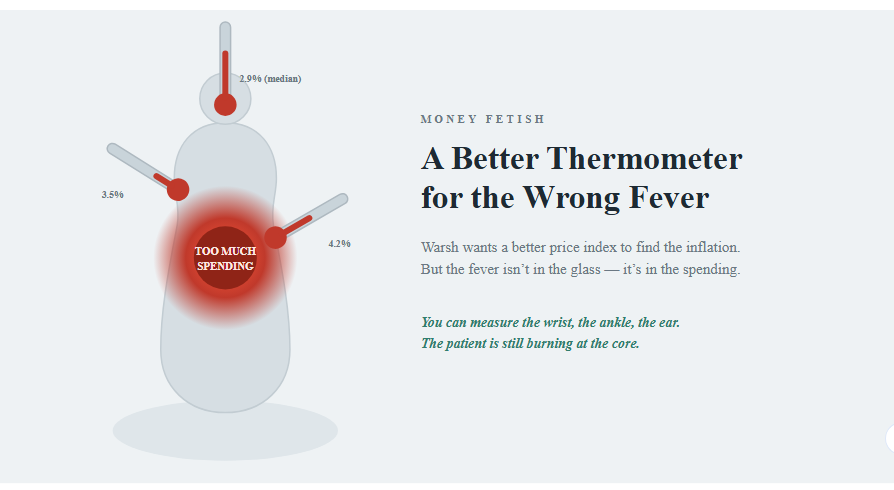
The individual prices are where the pressure shows up, not where it comes from. Hunting through them for the “true” signal is like taking a patient’s temperature at the wrist, the ankle, the forehead, and the ear, deciding none of the readings is trustworthy, and commissioning a better thermometer — when the fever is systemic and the question was never which limb to measure.
The medians and trimmed means make the confusion concrete. Why does anyone strip out the “outliers”? Because when a supply shock sends one sector’s prices flying — oil, used cars, eggs — you want to see past it to the broad trend. Fine.
But notice what that instinct concedes: it concedes that the thing you are trying to isolate is broad-based nominal pressure, the co-movement of prices that comes from too much spending, as against the relative-price noise that comes from supply shocks in particular sectors.
The trimmed mean is a clumsy, backward attempt to recover a nominal-demand signal from price data — to strip away the supply story and find the demand story underneath.
And there is a series that already is that signal, measured directly, no trimming required: nominal GDP. Warsh is trying to reverse-engineer, from thousands of noisy prices, the aggregate his own institution could simply target. He is looking for the shadow and ignoring the object casting it.
His big-box example gives the whole game away. He is “super interested” in the mean or median price of a good at a big retailer. But a single retailer’s price is the product of a hundred things that have nothing to do with monetary policy — the firm’s margins, its supply contracts, competition on the aisle, a port delay, the price of diesel.
If that price rises, has the Fed lost control of inflation, or did Walmart’s freight cost go up? The chairman cannot tell you, and no new index will tell him, because the question is misleading. He is asking a microeconomic question — what is this good’s price — and expecting a macroeconomic answer about the stance of policy. The two live on different floors of the building.
And here is the part that turns a conceptual error into a policy danger. A Fed that reads inflation off a better price index will, by construction, respond to the wrong things.
It will see a supply shock — oil spiking as the Middle East war reignites, the AI buildout bidding up power and chips and construction — register in its shiny new gauge, and it will tighten into it, because the gauge cannot distinguish “the economy got more expensive to run” from “the Fed created too much nominal demand.”
It will mistake a relative-price change for a monetary one and crush output to fight a number that a nominal-spending target would have correctly looked through.
The obsession with the perfect thermometer is not harmless fussiness. It is the exact intellectual apparatus that produces overtightening in supply shocks and complacency in demand booms — which is to say, it gets the two situations that matter precisely backward.
The bitter irony is that Warsh, in the same testimony, said the correct thing and then walked away from it. Underlying inflation over long horizons, he told the committee, “is determined largely by monetary policy.” Yes.
So the underlying inflation he is desperate to measure is not hiding in the median price at a big-box store. It is sitting in the growth rate of nominal spending, which is currently running above six percent and climbing, and which no amount of trimming, medianing, or retail-price sleuthing will change by a single basis point.
He has the diagnosis in one sentence and spends the next paragraph looking for it in the wrong organ.
A chairman who thought inflation was a monetary phenomenon would not be shopping for price indices. He would be watching nominal GDP and asking whether the Fed is letting it run too hot — and today it plainly is.
A chairman who goes looking for a better thermometer has already told you he thinks the fever is in the glass. It is not. It never was. And the confidence with which he promises to cure it, while searching for the wrong instrument to detect it, is not reassurance. It is the sound of a man about to treat the reading instead of the patient.
Admirable concatenation of metaphors contrasting micro and macro. But how do we know that it does not require NGDP growing at 6% to iron out the wrinkles in relative prices arising from Iran, from the tariffs from the deportations from the extreme sector specificity of investment in AI rollout? Even if we knew that 4% is optimal inflation-minimizing/real income-maximizing rate over the long term with normal levels of shocks, that tells us nothing about what the optimal inflation-minimizing/real income-maximizing rate in 2026 Q2 is.
Who is to say that hints may not be found in comparing headline with indexes that capture price (none) movement in sticky price sectors.
And recall that fever, the body's "temporarily over-target" temperature, is adaptive; it's cells can tolerate the extreme heat more than many bacterial.
When there is a big upwards cost shock, it is an overwhelming bet that the corresponding price will go up a lot, especially if the industry is running near flat-out whether or not it is characterized by market power.
When there is a big negative cost shock, more often than not the price will not go down by much. Instead, rather than cut their prices and continue their provision, industries that are not with market power will cut back on provision in order to maintain close to per-unit revenue.
Thus in a world in which there are a lot of cost shocks, whether transitory or more permanent due to resource depletion or technological progress, while have an upward gap between the average price increase and the median. Or so it will be as long as either the transitory or resource-depletion permanent cost shock is confined to a small part of the economy or the technology shock is of the leading sector-focused Schumpeterian creative-destruction type.
Some thought would then lead one to the conclusion that there is then something like a natural rate of average inflation: the median inflation rate consistent with "effective price stability", whatever that may be, plus whatever wedge balances the equities between the informational costs of nominal price instability on the one hand and the smooth and proper greasing of structural change via the appropriate relative-price signals. If one wanted a market signal-based monetary policy that took account of these considerations, one could do worse than look at the median rate of price increase.
Not, however, to say that Kevin Warsh thinks along these lines. Instead, he seems to have some view that median inflation gets you a better forecast of future inflation than either headline or core inflation does. That has not been demonstrated to me.
> **Marcus Nunes**: A Better Thermometer for the Wrong Fever <https://marcusnunes.substack.com/p/a-better-thermometer-for-the-wrong>: The chairman of the Federal Reserve, one meeting into the job, having just staked the institution’s credibility on defeating inflation, has told the world that his problem is finding the right price index. Not the right policy. The right thermometer. This is the oldest error in monetary economics wearing a data-science costume, and it deserves to be named, because a great deal of bad policy has been built on it.... The trimmed mean is a clumsy, backward attempt to recover a nominal-demand signal from price data.... And there is a series that already is that signal, measured directly, no trimming required: nominal GDP..... Here is the part that turns a conceptual error into a policy danger. A Fed that reads inflation off a better price index will, by construction, respond to the wrong things...
======
**DELONG’S GRASPING REALITY: Trying to make my readers—and myself—smarter. I think I am a go-to source to understand things economic in the past and in the present. Too online since 1995. Subscribe! <https://graspingreality.substack.com/subscribe>Currently featuring**:
* The Fourteen-Lion Parade <https://braddelong.substack.com/p/fourteen-lion-parade>
* DRAFT: Notes on Human Division-of-Labor Globalization from Stone Tools to the Assembly Line: -750000 to 1945 <https://braddelong.substack.com/p/draft-notes-on-human-division-of>
* Consequences of the Revolutions of 1848: Élite Recognition that "If Everything Is Going to Stay the Same, Everything Has to Change..." <https://braddelong.substack.com/p/draft-consequences-of-the-revolutions>
======
<https://marcusnunes.substack.com/p/a-better-thermometer-for-the-wrong>