Warsh Built a Tournament Too
The new chairman has handed his monetary-policy review to five outside task forces and fifteen co-leaders.

The lineup is heavyweight and, on the framework question, revealing — because the one contender it is structurally set up not to examine is the one this newsletter keeps arriving at.
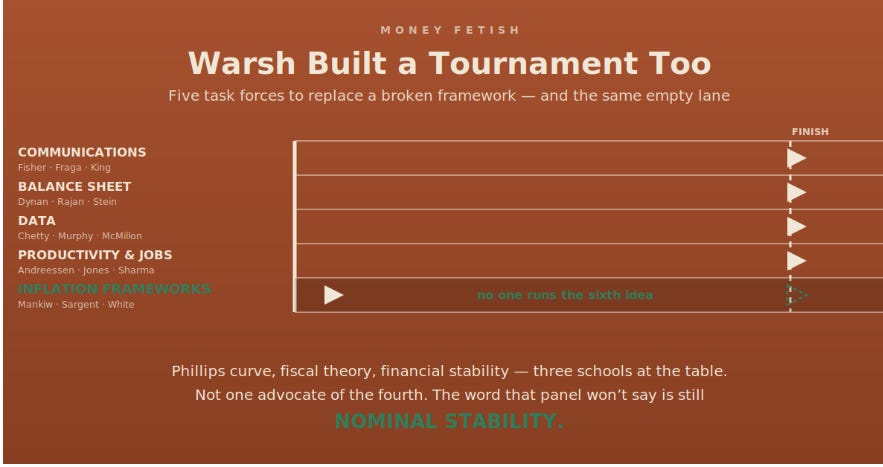
Kevin Warsh has turned his promised “regime change” into an org chart. On Thursday the Fed named the leaders of five task forces — communications, balance sheet, data, productivity and jobs, and inflation frameworks — fifteen external co-leaders in all, charged with reviewing the institution’s means and methods and reporting recommendations to the FOMC by year-end (see here for the Fed’s own release, and here and here for the coverage).
It is a serious roster. It is also, read closely, a tournament with a familiar hole in the bracket.
Give Warsh the credit first, because parts of this are overdue. The response-rate decay in the government surveys the Fed leans on is real, and a data task force willing to bring in timely, high-frequency measures is addressing an actual problem rather than an imagined one.
Pulling back on forward guidance in favor of a stated reaction function — already visible in June’s shorter statement — is a defensible correction, one I have argued was the right grammar even when I thought it aimed at the wrong noun.
And the outside co-leaders are not courtiers: William White warned about easy money before 2008, Raghuram Rajan warned before that, Mervyn King ran the Bank of England, and Thomas Sargent has a Nobel for the expectations revolution. This is not a panel of yes-men.
But the question that decides everything is which framework replaces the one the Fed just scrapped. Flexible average inflation targeting is gone, and Warsh has said almost nothing about the successor. The inflation-frameworks task force is where that gets decided, and its three co-leaders are Greg Mankiw, Thomas Sargent, and William White.
Look at what that lineup can and cannot contain. Mankiw is the dean of New Keynesian textbook macro — the Phillips curve, the sticky-price model, the very apparatus whose failure to see 2021–22 coming is the reason a review is happening at all.
Sargent is the fiscal-theory and rational-expectations tradition, the intellectual sibling of the account John Cochrane has spent a book defending.
White is the BIS financial-stability tradition, the man who watched credit rather than prices. Three serious schools, three real critiques of the status quo. And among them, not one advocate of the idea that the Fed should target the level of nominal spending.
That is the empty lane, and I have described this exact shape before. When I read Cochrane’s book I argued that his tournament of inflation theories ran five contestants and left the sixth — the nominal-demand view, the claim that the central bank controls the expected path of total nominal spending and that path is the anchor — out of the race entirely (see here).
Warsh has now done the institutional version. His framework panel spans the Phillips curve, the fiscal theory, and financial stability, and it does not contain a single person who would walk in and say the successor to FAIT should be a nominal GDP level target. The most consequential of the five task forces is the one least equipped to name the regime its own mandate is searching for.
This is not a complaint that the wrong people were chosen. Mankiw, Sargent, and White belong on any serious list. It is a complaint about the shape of the list — that a review convened precisely because the old framework misread the post-pandemic inflation has been staffed so that the framework built to get that episode right cannot be argued for from inside the room.
A committee reasons toward the union of what its members already believe. Put three traditions in a room and you get a synthesis of three traditions. The fourth does not emerge from a panel that contains none of its advocates; it has to be carried in by someone, and no one was invited to carry it.
The productivity-and-jobs panel deepens the worry, because it bears directly on the live question. That group is led by Marc Andreessen, alongside a Microsoft executive and Stanford’s Charles Jones.
Its brief is how AI affects productivity, jobs — and, through the June minutes, inflation. Recall what those minutes said: the staff marked up its inflation forecast partly for “the effects of the AI buildout on consumer prices,” and the committee debated whether AI demand would raise inflation or whether AI productivity would lower it.
That is not a settled empirical matter. It is the exact fork this newsletter has been arguing about — whether the AI capex wave is disinflationary through productivity or inflationary through a steepening supply curve meeting hot nominal demand.
And the person now helping the Fed frame it is the most prominent venture capitalist in AI infrastructure, with a direct financial stake in the answer coming out “productivity, therefore lower rates for longer.”
His individual integrity is not the issue. The governance is: you do not put an interested party in charge of framing the question whose answer moves his portfolio.
So I have doubts. The task-force form is a technology for building consensus, not for holding a contest — Fed-watchers already read it as Warsh persuading his colleagues rather than overruling them, which lowers the odds of a reckless break and, in the same motion, lowers the odds of a real one.
The likely product is a shelf of well-argued reports that ratify the chairman’s instincts with academic dressing. On data, the instinct is partly right. On communications, half right. On the framework — the decision that will outlast every other — the panel has been composed so that the answer I think the evidence points to is the one answer that has no advocate at the table.
The tell, as always, is not who is on the list. It is who is not. Warsh built a tournament to replace a framework that failed, and left out the contestant built to succeed it. The word that panel is least likely to say is the same word the pendulum, the empty corner, and the empty lane have all been circling. It is still Nominal Stability— and the Fed just guaranteed no one in the room will propose it.
As a practical matter, what's the difference between what a New Keynesian, a fiscal theory guy and a financial stability person target?
“… that a review convened precisely because the old framework misread the post-pandemic inflation has been staffed so that the framework built to get that episode right cannot be argued for from inside the room.”
There is a bit of circular reasoning here. You _assume_ that the post pandemic inflation was "misread" but that is becasue you_ assume_ (something like) that having prevented NGDP from exceeding its pre-pandemic trajectory would have produced the (smaller) right amount to inflation without causing unemployment of resources. How do we know that?
The same occurs in your implicit praise of White and Rajagopalan for “warning” about easy money before 2008. Was the warning justified? WAS money “easier” than needed to maximize real growth? [This is not to criticize their inclusion in the group as theirs is a legitimate point of view, but not ipso facto correct]
You are correct in your larger point, that the panel does not include a spokesperson for NGDPLT like Beckworth or Sumner. But likewise, it does not include a spokesperson for FAIT. And stepping back farther, rather than just asking the panel to pick the best target from the expanded list, why not charge them to develop the target from first principles. And should they be developing a target or a rule?