Two Reports, One Story
The payroll data and the yield curve are no longer telling different stories. They are telling the same one.

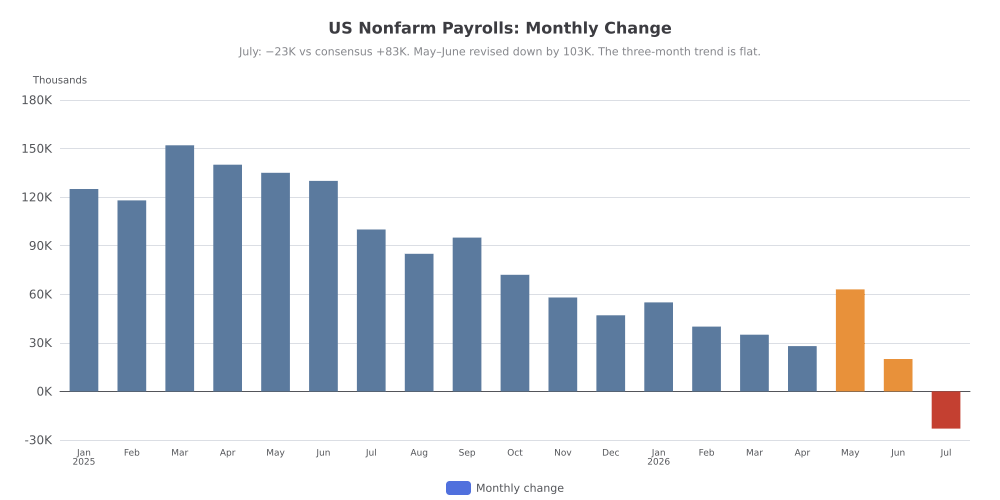
The US economy lost 23,000 jobs in July. The consensus was for a gain of 83,000. The prior two months were revised down by 103,000 combined. The three-month moving average is now essentially flat.
The unemployment rate fell to 4.1 percent. That sounds like good news. It is not.
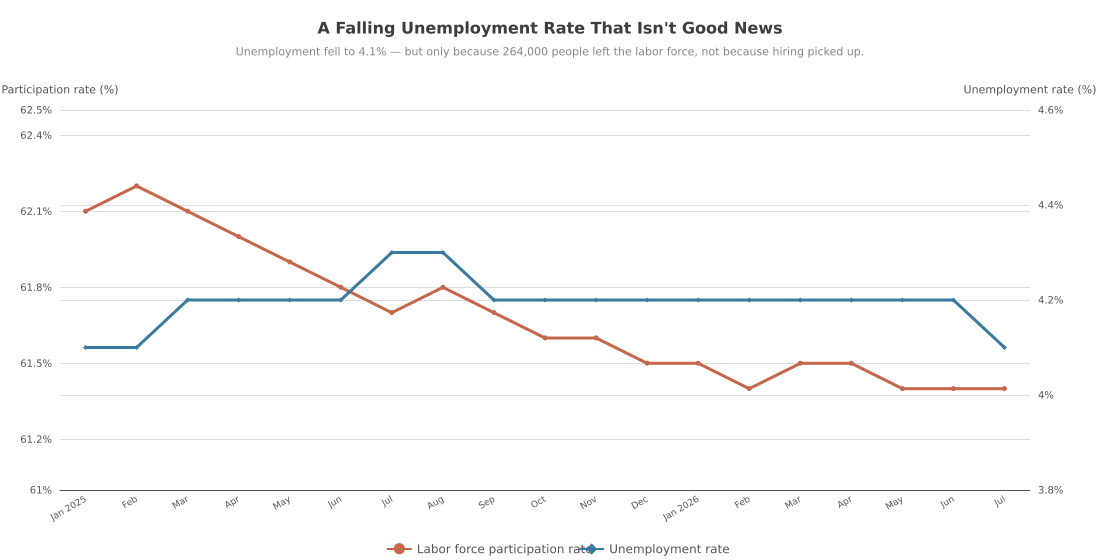
The rate fell because 264,000 people left the labor force — they stopped working and stopped looking. The participation rate dropped to 61.4 percent, its lowest in more than five years.
Household employment — the survey that counts actual people with jobs — fell by 87,000. Temporary layoffs jumped by 153,000. This is not a tightening labor market. It is a withdrawing one.
A negative payroll print, collapsing participation, downward revisions, and an unemployment rate that fell for the wrong reason. In normal times, that would be a clear signal: the economy is slowing, and the central bank should ease.
These are not normal times.
The other half of the picture
Nominal GDP grew at a 7.9 percent annualised rate in the second quarter. Year-on-year, it is running at roughly 6.5 percent — well above any plausible estimate of the economy’s sustainable speed limit.
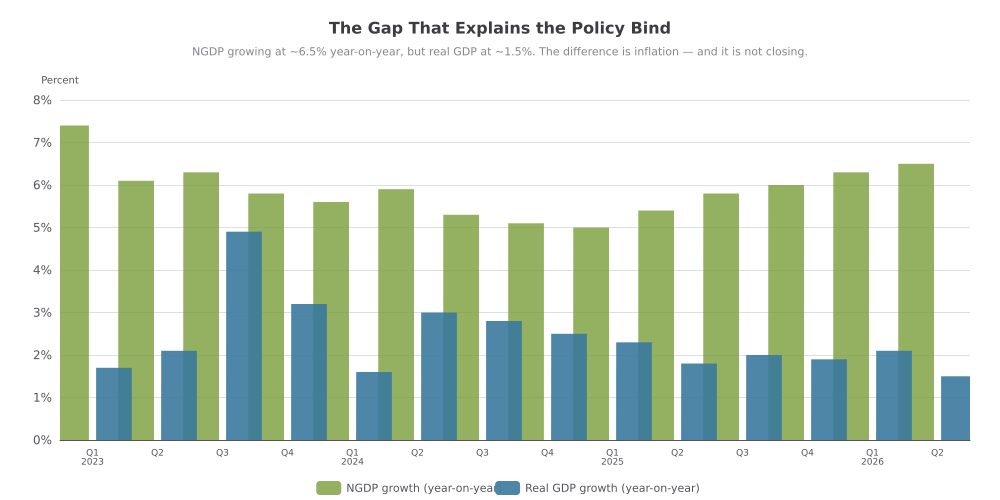
The gap between the green bars and the blue bars — between NGDP growth and real GDP growth — is the excess nominal spending that shows up as inflation. And it is not closing.
Real GDP grew at 1.5 percent in Q2. The GDP price index ran at 5.1 percent. Core PCE inflation, the measure the Fed officially targets, was estimated at 3.3 percent year-on-year in June, down only marginally from 3.4 percent in May. The monthly CPI prints — 0.9 percent in March, 0.6 percent in April, 0.5 percent in May — are not consistent with a return to 2 percent.
Now put the two halves together. The labor market is weakening. Nominal spending is still running hot. Inflation is stuck above 3 percent. And the gap between NGDP growth and real growth — roughly four to five percentage points — tells you that monetary policy, judged by the outcome that matters, is still expansionary.
This is not a contradiction. It is a description of an economy in which demand is still being fed faster than the supply side can absorb it, but the supply side is fraying at the edges — fewer people willing or able to work, layoffs concentrated in cyclically sensitive sectors, an unemployment rate that falls only because workers give up. It is not a recession. It is the precursor to something worse.
The bond market already priced this
Nine days before the payroll report, on 29 July, the yield curve delivered a message that looked puzzling at the time.
The two-year yield fell — traders concluding that Fed Chair Kevin Warsh, having declined again to explain why he was not raising rates with inflation above target, is more dovish than they had assumed. The thirty-year yield rose, touching its highest level since 2007.
Short end down, long end up: a twist, not a shift.
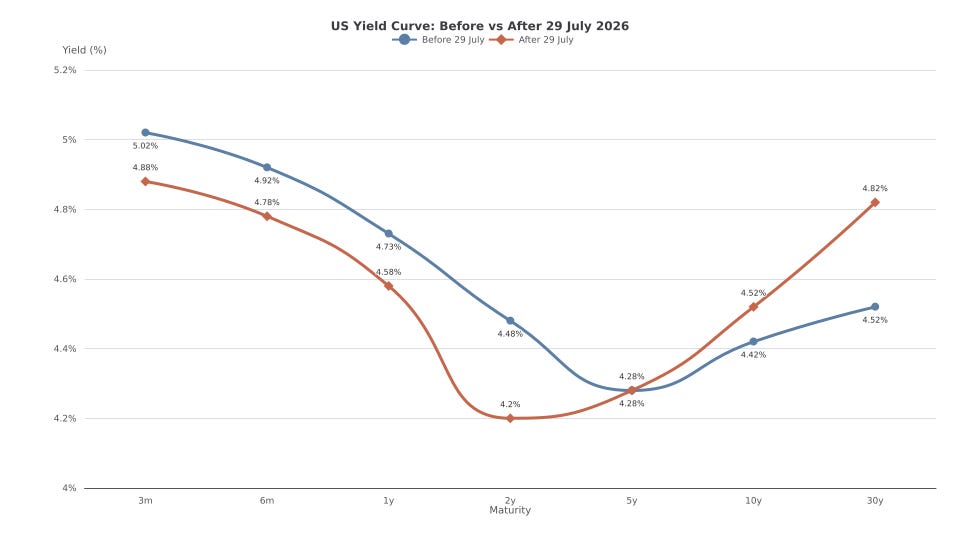
At the time, the twist looked like a story about the term premium — the missing nominal anchor widening the compensation investors demand to hold long-dated debt. It was that.
But it was also something else. The bond market was pricing, in advance, exactly the tension that the payroll report made explicit: a labor market soft enough to pull the short end down, and an inflation outlook persistent enough to push the long end up.
The payroll data confirmed both legs of the trade. The twist was not a one-day anomaly. It was the shape of the contradiction, visible in the curve before it was visible in the data. And it has widened since.
The missing framework
In a textbook world, weak payrolls and high inflation pull policy in opposite directions, and the central bank’s framework resolves the tension.
If the priority is inflation, the Fed says so, and the short end reprices upward. If the priority is employment, the Fed says so, and the long end widens on inflation-risk premium. Either way, the framework anchors one side of the trade-off so the other can adjust.
Warsh has stated neither priority. He has declined to name a nominal target or a reaction function. The result is that both ends of the curve are unanchored simultaneously — and both are deteriorating at once.
The short end prices easier policy on every soft data point. The long end prices higher inflation compensation on every sticky price print. They move in opposite directions not because the market is confused, but because it is doing, in real time, the adjudication the Fed has refused to do.
This is the fiscal-monetary loop in operation. An unanchored long end raises the term premium, which raises the interest bill, which widens the deficit, which raises the term premium further.
A softening labor market, absent a framework, pulls the short end down without pulling inflation expectations with it — because nothing pins the price level thirty years out.
The twist is the mechanism. It is not a curiosity of the bond market. It is the transmission channel through which an absent nominal anchor becomes a drag on the real economy.
Discretion is not free. It is being expensed at both ends of the curve — and now, in the payroll data, at the household level as well.
What to watch
The preliminary benchmark revision to the establishment survey data arrives on August 28. If it confirms what the monthly revisions are already hinting at — that payroll growth has been systematically overstated — the entire picture of 2025–2026 job growth will be revised down, perhaps materially.
The bond market will absorb that before the Fed speaks. The twist will widen further, because the two ends of the curve are now pricing two different crises that the Fed has declined to adjudicate between, and every data point that worsens both halves of the contradiction will be priced at both ends simultaneously.
A central bank that keeps its options open is not being cautious. It is quietly raising the price the Treasury pays to borrow, at the moment the Treasury can least afford it — and now, with payrolls printing negative, it is doing so against a labor market that is softening on both the establishment and household surveys.
The bill is itemised daily. The August payroll report, due the first week of September, will be the next entry.
Addendum: the stock market applauded
There is a final piece of the picture, and it is the one that makes the whole configuration harder to dismiss as an academic concern.
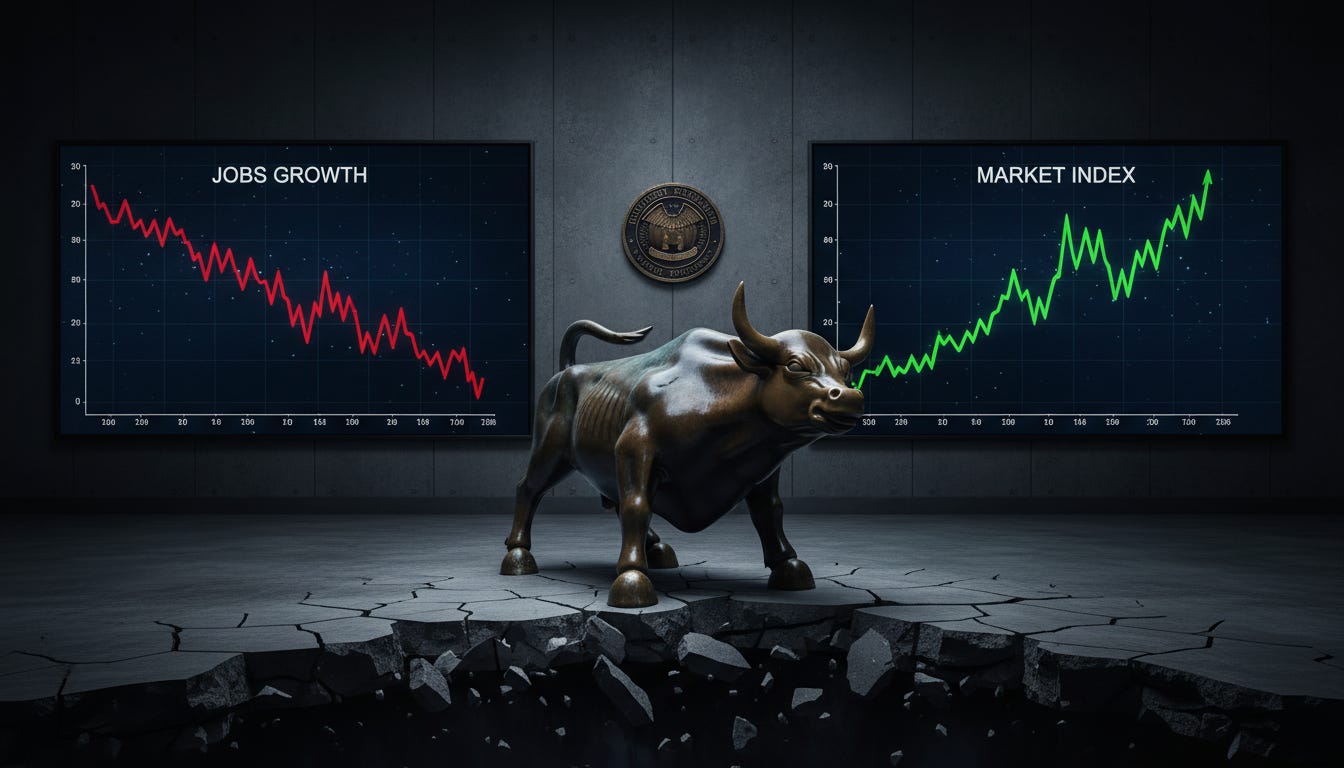
The S&P 500 rose 0.5 percent on the morning of the report. The Nasdaq gained 1 percent. Equities rallied, bonds rallied, precious metals rallied.
The mechanism is familiar: bad news on payrolls means the Fed is less likely to raise rates, and easier policy lifts asset prices. Wall Street has been running this playbook for two decades. “Bad news is good again,” as one headline put it.
But the logic deserves a harder look, because it is not obviously sound under the present conditions.
The rally rests on a single assumption: that the labor market is softening enough to force rate cuts but not enough to threaten earnings. (What Maria Bartiromo at Fox News today called a “Goldilocks” economy!)
Every rate-cut rally is, at bottom, a bet that the central bank will deliver monetary relief faster than the real economy deteriorates. In a world with 6.5 percent NGDP growth and inflation still above 3 percent, that is a narrow window to aim for.
The market is pricing a path in which payrolls weaken, the Fed eases, nominal spending stays buoyant, and profit margins hold. It is pricing, in effect, a controlled disinflation that requires no sacrifice of output — the immaculate cooling that central bankers dream about and rarely deliver.
There are three ways that bet can go wrong, and each is live.
First, the Fed may not deliver the cuts the rally expects. Warsh has no framework. He has not stated what he is targeting or what conditions would cause him to move.
The market is extrapolating a reaction function from a Fed chair who has declined to provide one. That means the rate path being discounted into equities is built on an assumption about Warsh’s preferences — dovish, reactive to labor data — that he has never confirmed and could repudiate in a single press conference.
A rally that depends on a dovish interpretation of a Fed that refuses to interpret itself is a rally built on sand.
Second, the inflation data may not cooperate. NGDP at 6.5 percent, core PCE at 3.3 percent, monthly CPI prints that are not decelerating — this is not a backdrop against which rate cuts are costless.
If the Fed eases into sticky inflation, the long end widens further. Rising long yields tighten financial conditions through mortgage rates, corporate credit spreads, and the dollar — exactly the channels the equity market is betting will loosen.
A rate cut that widens the term premium can leave financial conditions tighter than they were before the cut. The rally assumes the short end does the work. The bond market is already pricing the opposite.
Third, and most fundamental: the bad news may eventually become bad news.
The payroll report was not a gentle cooling. It was a 106,000-job miss against consensus, a 103,000 downward revision, an 87,000 decline in household employment, a 264,000-person exodus from the labor force, and a 153,000 jump in temporary layoffs — the category that most reliably precedes permanent job losses.
A stock market that rallies on those numbers is betting that the weakness stays quarantined on Main Street and never reaches corporate earnings. That is a bet that has been wrong at every cycle turn in modern history.
The “bad news is good” trade works when the central bank has room to ease and the real economy is not yet deteriorating in a way that threatens profits.
It stops working when the bad news crosses the line from “slowing” to “contracting,” and that line is not visible in advance.
The July report may or may not be the one that marks the crossing. But the participation collapse, the temporary-layoff spike, and the concentration of losses in cyclical sectors all point in the same direction — and the equity market is looking the other way.
The yield curve and the stock market are now telling directly contradictory stories.
The yield curve says: easier policy at the short end, higher risk at the long end, the persistence of inflation, and the drag of a missing anchor.
The stock market says: easier policy is all that matters, and everything else will take care of itself. They cannot both be right.
And in every previous episode in which the bond market and the equity market have diverged this sharply on the interpretation of a payroll report, it was the bond market that ultimately prevailed — because the bond market is in the business of pricing constraints, and the equity market is in the business of pricing hopes.
The constraint here is not merely cyclical. It is institutional. And it is not being priced into equities at all.
Its a scenario unfolding professor. It depends on other blocks unfolding, like a miss in the current AI capex, that looks to me the only game in town currently. Households spending is beginning to slow down as well in the high frequency data. Savings are at a historical low, and real wages growth are trending toward zero. NGDP is trending upward, but in an unhealthy way, with real GDP maintaining a low growth rate of 2% and the deflator increasing to 4.5% per year. The result is a decrease in purchasing power, even though the booming stock market softens financial conditions and accentuates the K-shaped economy. I can anticipate a crack in the current framework, but this is still a lower-probability scenario, in which the central bank's next move would be a cut rather than a hike. Let's see how the next few quarters play out.
We really need that market in Tilllionths. _It_ would not be based on hopes.