Trump’s War
When Strategic Incompetence Joins Hands with Out-of-Control Ignorance

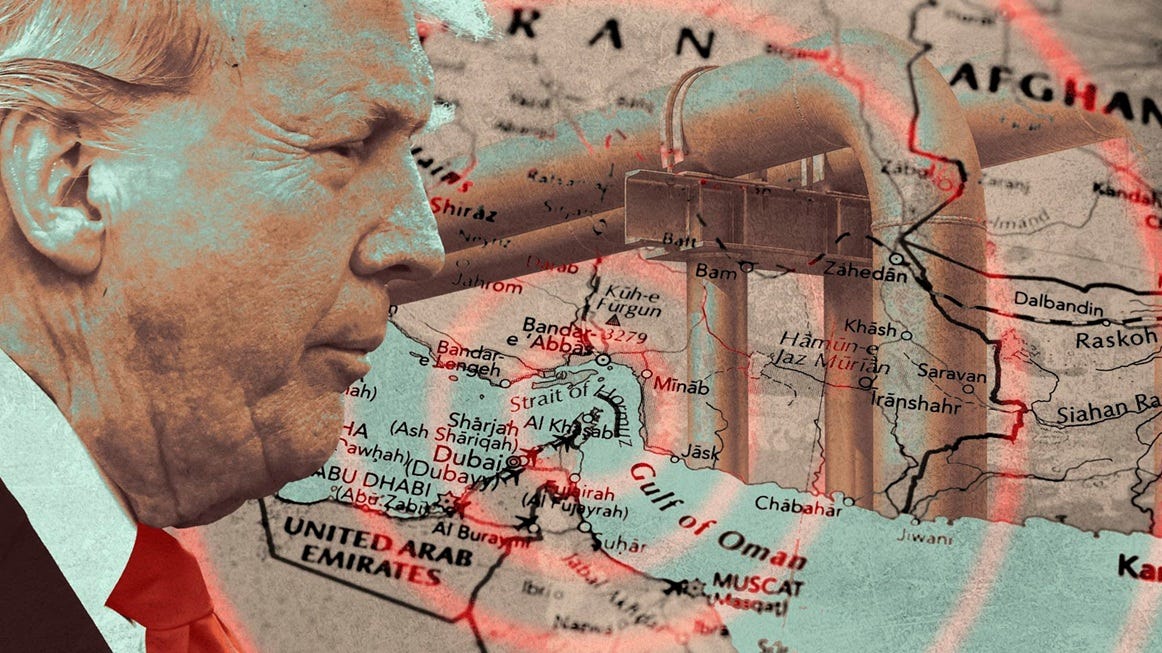
There is a particular kind of catastrophe that is worse than the kind produced by malice. Malice, at least, implies a plan. The war the United States is now fighting in Iran — launched on February 28, 2026, under the operationally grandiose name Operation Epic Fury — belongs to the other category.
It is a catastrophe produced by the intersection of two forces that, separately, are manageable, but together become something close to civilisational recklessness: strategic incompetence at the decision-making level, and an ideological contempt for the knowledge —embracing ignorance — that might have prevented the decision from being made.
This post is not an argument that the war could not have been justified. The argument here is different and more damning: that whatever justification existed was never seriously examined, that the decision was made in the absence of a plan for what came next, and that the ignorance was not incidental but structural — the predictable output of an administration that had spent years treating expertise as a form of elite condescension rather than a precondition for competent governance.
The Decision That Wasn’t Made
Serious wars begin with serious decisions. A serious decision about Iran would have required, at minimum, answers to four questions before the first bomb fell. What is the objective? What constitutes success? What comes after the regime, and who fills the vacuum? And what is the acceptable cost in oil markets, regional stability, and American blood and treasure if the operation runs long?
There is no publicly available evidence — and considerable private evidence, from officials who spoke to the press within the first week — that any of these questions received satisfactory answers before February 28.
What the record shows instead is the structure of an opportunity seized, not a strategy executed. An intelligence window opened: Iranian leadership was gathered, the moment was rare, the temptation was overwhelming. A decision was made, apparently over a weekend, by a small group of principals whose defining characteristic was not strategic depth but personal loyalty to a president who regards preparation as a sign of hesitation.
The “no endgame” critique that emerged almost immediately from current and former officials was not, as the administration’s defenders claimed, the predictable carping of the foreign policy establishment. It was the accurate description of a plan that did not exist.
Richard Fontaine of the Center for a New American Security said the objectives were “all over the place.” European diplomats said they had “no idea” what Washington wanted when the war ended. Four anonymous officials told multiple outlets that the administration had no actual rationale, no endgame, and no plan for the aftermath. These are not partisan sources. They are the people who were inside the room.
Secretary of Defense Hegseth’s response — that Russia and China were “not really a factor” in the war — is worth pausing on, because it is not merely wrong. It is wrong in a way that reveals the relationship to evidence of the people running this war.
The intelligence his own officials were simultaneously leaking to the Washington Post, NBC, and CNN showed Russia providing Iran with real-time operational targeting data against American forces.
The gap between what Hegseth said publicly and what his own intelligence community knew privately is not a communications problem. It is a governance problem. It suggests either that the Secretary of Defense was not being briefed on the most consequential intelligence picture of an active war, or that he was briefed and chose to deny it anyway. Neither possibility is reassuring.
The Ignorance That Was Chosen
The word ignorance in this context requires precision. It does not mean the absence of information. The United States government possesses, in its intelligence apparatus, its State Department, its academic and policy infrastructure, more accumulated knowledge about Iran, the Persian Gulf energy architecture, and the geopolitics of the Strait of Hormuz than any institution in human history.
The ignorance that produced this war was not an informational deficit. It was a chosen blindness: the systematic exclusion of expert knowledge from the decision-making process, institutionalised across the first Trump administration and deepened in the second.
This process has a name in the bureaucratic literature: it is called the politicisation of intelligence, and it runs in two directions simultaneously. The first direction is the exclusion of analysis that complicates preferred conclusions. The second is the promotion of advisors whose primary qualification is ideological alignment rather than subject-matter competence.
The combination produces what we now have: a national security apparatus populated at its senior levels by people who have never governed a complex system, advised by a president who has spent his career treating knowledge as a negotiating tactic rather than a constraint on action.
The consequences were entirely predictable — and were predicted. The Hormuz closure was not a surprise to any serious analyst of Persian Gulf geopolitics.
The drone-based insurance withdrawal mechanism — Iran’s ability to effectively close the strait not through a naval blockade but through cheap drones targeting the psychological threshold of shipping insurers — had been extensively modelled and written about for years.
[Note: Sen. Andy Kim (D-NJ): “I worked at Pentagon, State and WH on Middle East and every assessment about possible conflict with Iran started with the real possibility of closing Strait of Hormuz. I guarantee Trump leaders were warned. They just thought they were better than the experts.”]
The fertiliser transmission chain, the semiconductor energy exposure, the food system cascade through the Global South: these were not exotic analytical products. They were available in open-source analysis, in classified assessments, in the institutional memory of every Gulf specialist the administration had systematically sidelined.
The question is not whether the administration could have known. The question is why knowing was not considered necessary. The answer lies in a political culture that has spent a decade constructing expertise as the enemy of authentic leadership.
When you have successfully persuaded your base that the accumulated knowledge of professionals is merely the self-interested ideology of an elite, you have not liberated yourself from expert constraints. You have simply removed the fire alarm and called it freedom.
The Costs Are Not Abstractions
By Day 9, the opening balance sheet was already being written. The Strait of Hormuz effectively closed. Qatar’s LNG production halted. Iraq cutting 1.5 million barrels per day. Kuwait’s refining output curtailed. Roughly 170 containerships trapped inside the strait.
Oil at $119 intraday before retreating on strategic reserve release speculation. European natural gas up 30 percent. And the number almost entirely absent from the public conversation: one third of global fertiliser trade passes through that strait, and planting season decisions for 2026 harvests were being made under conditions of extreme input cost uncertainty.
These are not abstractions on a risk matrix. They are the beginning of a cascade that, if the war extends beyond six weeks, will reach the food systems of South Asia, Sub-Saharan Africa, and North Africa — populations already at the margin of food security, already carrying the compound damage of pandemic debt, Ukraine-driven food inflation, and elevated dollar-denominated debt service costs.
The Arab Spring was triggered by a smaller food shock under more resilient initial conditions. The people who will bear the full weight of this cascade did not vote for Trump. Many of them have never heard of him. They will nonetheless pay the price of his strategic recklessness in the only currency that cannot be refinanced: hunger and political collapse.
Then there is the gift being delivered, with remarkable efficiency, to the “others”. Russia’s energy revenues are surging as Hormuz disruption tightens global oil markets and the US temporarily lifts sanctions on russian oil sales. Those revenues directly fund the war in Ukraine.
China is using Iran as a live laboratory to stress-test Western sanctions architecture and map circumvention routes in real time — preparation, openly acknowledged by analysts, for the economic warfare dimensions of a future Taiwan scenario.
Every carrier strike group the United States commits to the Gulf is one less available in the South China Sea. The strategic distraction could not have been better designed for Beijing’s purposes if Beijing had designed it, and the haunting possibility is that in some meaningful sense, it did.
The Trump Doctrine and Its Discontents
There is an interpretation of this war that flatters the administration. It goes like this: Trump, unconstrained by the procedural timidity of the foreign policy establishment, seized a rare intelligence window to decapitate Iranian leadership, degrade its nuclear programme, and reshape the Middle East in a single bold stroke.
The apparent chaos is not incompetence — it is creative destruction, the application of business-world disruption logic to a sclerotic geopolitical order.
This interpretation is seductive and wrong. Creative destruction in business works because the market provides feedback mechanisms — price signals, bankruptcy, competition — that discipline bad decisions over time.
Geopolitics has no such mechanism. The feedback, when it comes, arrives as wars, famines, and the collapse of the institutional architecture that took eighty years to build. The “move fast and break things” philosophy that produced modest value in consumer technology produces something categorically different when applied to the Strait of Hormuz.
The more honest version of the Trump doctrine is not creative destruction but reckless opportunism rationalised after the fact as strategy.
The intelligence window opened. The temptation was irresistible. The decision was made. The strategy — to the extent one can be identified — was assembled retrospectively from the wreckage of whatever objectives turned out to be compatible with what had already been done.
This is not Clausewitz. It is not even coherent. It is the application of the Mar-a-Lago deal-making temperament — where the goal is always to create maximum pressure and confusion and then extract a win from whatever the confusion produces — to a theatre where the parties on the other side are not contractors negotiating a hotel refurbishment but a nuclear-adjacent state with nothing left to lose, backed by two great powers with a decade-long interest in American overextension.
The day Trump told a CBS reporter that the war was “very far ahead of schedule” and “very complete, pretty much” — while Israel was simultaneously launching a second wave of broad strikes on Tehran — the distance between the president’s stated reality and the operational reality became a measurement of something more than rhetorical excess.
It became a measurement of the fundamental cognitive condition of a man conducting a war: unable or unwilling to distinguish between his preferred narrative of events and the events themselves.
What Competence Would Have Looked Like
It is worth, briefly, imagining the counterfactual — not because it changes anything, but because it clarifies what was absent.
Competent conduct of this operation would have begun with a defined and stable objective, agreed across the principal decision-makers before the first strike.
It would have included a day-after plan for Iranian governance, developed in consultation with regional partners and Iran’s domestic opposition. It would have pre-positioned a diplomatic framework for the Hormuz question — explicit commitments to Gulf producers, coordinated strategic reserve release, and back-channel signals to China about energy continuity.
It would have briefed European allies not as an afterthought but as a precondition, understanding that the political sustainability of the operation depended on coalition coherence.
It would have modelled the fertiliser and food cascade and pre-staged humanitarian response mechanisms. And it would have taken seriously the intelligence about Russian targeting support from day one, rather than publicly dismissing it while officials leaked the opposite to every major news outlet.
None of this is hindsight. It is the baseline standard of competent governance in matters of war. It is what the foreign policy professionals Trump spent a decade demonising were trained to do.
Their exclusion was not a strategic choice. It was an ideological one, made for domestic political reasons, at the cost of the people — in Iran, in the Gulf, in South Asia, in Sub-Saharan Africa, in Ukraine — who are now living with the consequences.
The Reckoning
The word accountability rarely survives contact with the Trump political ecosystem. The mechanisms that normally discipline strategic failure — congressional oversight, a free and adversarial press, the rotation of electoral punishment — have all been weakened in ways that make the standard reckoning improbable. What remains is history’s reckoning, which is slower and less satisfying but ultimately more durable.
History will record that the United States, at the height of its military and economic power, launched a war against a regional adversary without a plan, without a coalition, without a post-conflict framework, and without the faintest acknowledgment of the systemic economic cascade it was about to unleash on populations that had no voice in the decision.
It will record that the president celebrated the war’s progress in one sentence and denied its continuation in the next, that his Secretary of Defense contradicted his own intelligence community in public, and that the administration’s response to the most consequential intelligence finding of the war — Russia targeting American forces through Iranian proxies — was to call it “not really a factor.”
It will also record what was available to be known, and when. The Hormuz vulnerability was documented.
Strategic incompetence, at the scale now on display, is not merely a policy failure. It is a moral one. Because ignorance, at this level of power, is never truly involuntary. It is always, at some point, chosen. And the people who bear the cost of that choice are, almost without exception, not the people who made it.
PS: The ignorance headlined: Trump: ‘When oil prices go up, we make a lot of money’
Observation: The Strait of Hormuz has never been closed before 2026. What makes the current situation historically unprecedented is precisely this. Every prior conflict in the region produced threats, disruption, and harassment — but never an effective closure.
Hello Marcus, hope you're doing well. I had a paid subscription to your content, but I'm unable to access your paid posts. It appears that my subscription was cancelled automatically. Could you please help me understand how this happened?