The Vote Is the Statement
The July FOMC statement is the shortest in years and says almost nothing. That is the point of the new regime.

But three governors and presidents broke ranks to demand a hike, and the dissent list turns out to carry more information about monetary policy than the paragraphs above it.
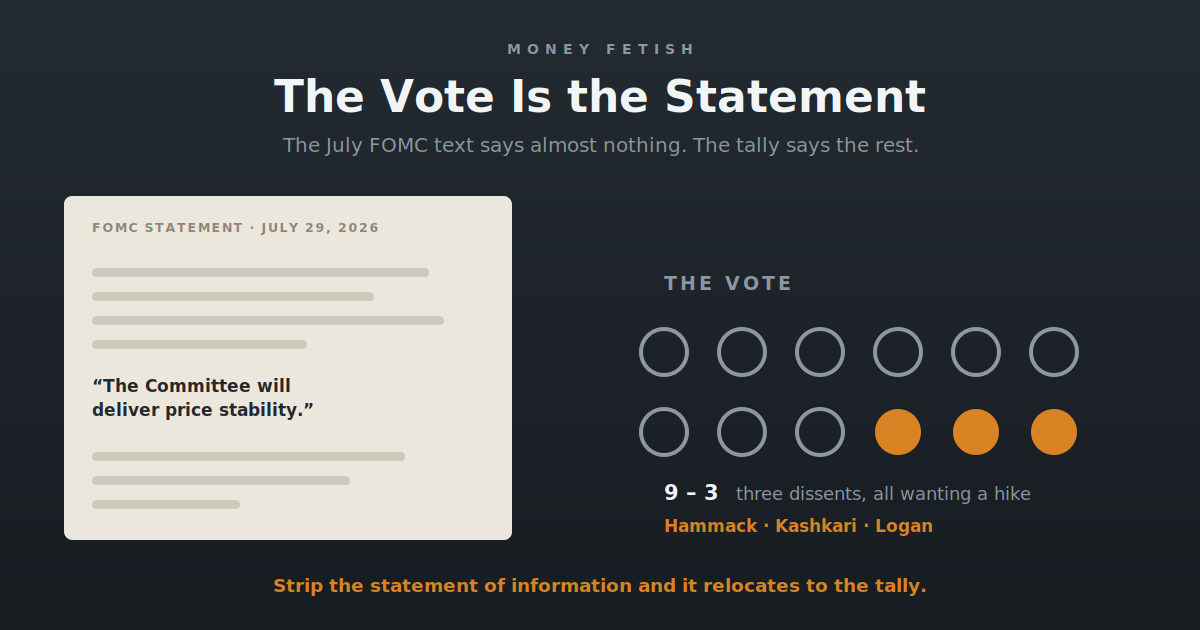
The Committee held at 3½ to 3¾ percent this afternoon and published a statement you can read in ninety seconds. There is no forward guidance. There is no balance-of-risks paragraph. There is no “the Committee anticipates,” no conditions attached, no hint of what would move the rate in either direction.
Kevin Warsh promised to strip the communications apparatus back to something a person could read, and on that narrow test he has delivered.
The question is what is left once you strip it. The answer today is a sentence: “The Committee will deliver price stability.”
That is not a policy. It is a posture. Bill Nelson made this point about Warsh’s Senate testimony a week ago and it applies with more force to a formal statement — declaring resolve and taking ownership are supposed to convey seriousness, but a commitment with no metric, no horizon and no stated response leaves the Committee committed to nothing.
You cannot miss a target you have not specified. If you are trying to price September off this text, it gives you nothing to price.
So the paragraphs are thin. Look at the last line instead.
Three dissents, one direction
Beth Hammack, Neel Kashkari and Lorie Logan all voted against, and all three wanted a quarter point higher. A 9–3 vote is a wide fracture by the standards of the modern Fed, where dissents are rationed and usually solitary.
What makes it interesting is that these three do not share a framework. They come to the table with different priors about inflation, different regional readings, different intellectual furniture.
When people who disagree about the model agree about the direction, that is stronger evidence than three hawks voting their type. They are looking at the same data as the majority and reaching the opposite conclusion about what the data require.
Notice the irony in this. The stated purpose of the new communications regime is to reduce noise and let the policy speak plainly. What actually happened is that the statement was emptied of information and the information relocated to the vote tally.
Anyone who wants to know the Fed’s reaction function now has to infer it from who broke ranks, which is a less precise instrument than the sentence Warsh deleted.
The inflation sentence
Here is the line that matters most for anyone who reads this newsletter regularly: inflation remains elevated “in part reflecting supply shocks that have driven price increases in certain sectors, including energy.”
That is a cost-push sentence. It explains the general price level by pointing at particular prices in named sectors.
Energy is a relative price — the price of oil against everything else — and a relative price cannot, by itself, move the level of all prices. If energy rises and nothing else changes, other prices must give ground. When they do not, something is holding total nominal spending up, and that something is monetary.
This is the confusion the series has been chasing all year, and it is now written into the Committee’s own text. It also sets up the conclusion it wants: if the inflation is coming from oil and supply chains, then it will pass, and the Committee can hold.
The arithmetic the statement does not mention
Put the numbers side by side. The funds rate sits at 3½ to 3¾ percent. Core PCE inflation is running near 3.4 percent. That leaves a real policy rate barely above zero — not restrictive on any plausible estimate of the neutral rate, and arguably accommodative.
Meanwhile nominal GDP growth on my own tracking is running near 6.5 percent, up from around 4.3 percent a year ago, and Divisia M4 has accelerated on the same path and turned first. Those are not the readings of an economy whose inflation is about to fade on its own. They are the readings of nominal demand running well above anything consistent with 2 percent inflation over time.
So the Committee is holding an accommodative real rate, while describing inflation as elevated, while attributing that inflation to oil. The three dissenters may not use my framework, but they are reaching the conclusion the arithmetic supports.
Where I would defend the Fed, and where the defence stops
It is worth being careful here, because the reflexive criticism is the wrong one.
A central bank should look through an energy shock. That is exactly what this newsletter has argued for years, and it is the strongest practical case for targeting nominal spending rather than a price index: a supply shock passes through to prices while the spending path holds, and the Fed declines to tighten into a real disruption it cannot fix.
If the Middle East conflict is raising oil prices, responding to that with higher rates would compound a supply problem with a demand contraction. The instinct not to chase energy is correct.
The trouble is that looking through is the only thing the Fed is doing. The case for tightening today has nothing to do with energy. It rests on nominal demand growing at seven percent against a path that should be growing at four.
The Committee cannot see that argument, because it does not watch that variable — and the statement, tellingly, contains no aggregate of any kind. Not nominal spending, not money, not credit.
Two weeks after the Monetary Policy Report reintroduced M2 for the first time in a decade, and after the chairman told the Senate that money matters, the actual policy statement mentions no quantity at all.
One more thing the statement does twice
“Productivity growth and capital investment are strong” enters the AI buildout on the benign side of the ledger — evidence the economy can absorb demand without inflation.
Yet the minutes of the June meeting reported that staff had marked their inflation forecast up, partly for “the effects of the AI buildout on consumer prices.” Within a month, the same phenomenon appears as a reason for comfort and as a reason for concern, with no attempt to reconcile the two.
Both readings can be partly right — the buildout adds supply eventually and strains capacity now — but a committee that has not decided which effect dominates has not decided what the capex wave means for policy. That is a substantive gap, and the shortened statement is very good at hiding it.
What a target would have said
Imagine the same meeting under a nominal spending level target. The statement would have one number in it: nominal GDP is running X percent above the announced path, the Committee expects to close that gap over Y quarters, and here is the rate consistent with doing so.
The dissenters would be arguing about the pace of closure rather than about direction, and the public would be able to score the Committee next quarter.
Instead we have a promise to deliver price stability, an explanation that points at oil, a real rate near zero, and three people at the table who think all of that adds up wrong.
The statement tells you the Fed will not say what it is doing. The vote tells you that inside the room, not everyone agrees it is doing enough. This month, the second is the more useful document.
Concerning future movements in policy instruments, saying nothing is appropriate.
Warsh is spot on. Velocity has peaked.