The First Ten Months
Measuring the Economic Damage of Trump’s Second Term

When Donald Trump took office for his second term on January 20, 2025, the US economy was imperfect but fundamentally sound: unemployment at 4.0%, inflation declining toward target, GDP growing at 2.8%, and consumer confidence recovering from pandemic disruptions.
Ten months later, in late October 2025, the economic landscape has deteriorated across multiple dimensions in ways that are measurable, documented, and increasingly difficult to dismiss as temporary turbulence. This isn’t about partisan interpretation of ambiguous data - it’s about tracking concrete indicators of economic health that have moved decisively in the wrong direction.
The Labor Market: From Resilient to Fragile
The clearest sign of deterioration appears in employment data. Job creation has collapsed from healthy pre-inauguration levels to anemic growth that suggests the economy is losing momentum.
Monthly job gains averaged 150,000-200,000 in late 2024. By September 2025, consensus forecasts suggested only 51,000 jobs added, with ADP data showing an outright loss of 32,000 private-sector positions. Even optimistic private-sector estimates like Revelio Labs showed only 60,000 jobs added - far below what’s needed to absorb new labor force entrants.
Unemployment has ticked steadily upward from 4.0% in January to 4.3% by August, with economists noting that another tenth or two of a point would push it to 4.4% - the highest since October 2021. This trajectory matters because historically, once unemployment starts rising, it rarely stops gently.
The bifurcation in the labor market reveals structural problems. Healthcare continues adding jobs robustly, but technology, professional services, and manufacturing are shedding workers or freezing hiring. This isn’t creative destruction - it’s demand weakness spreading through sectors that typically lead economic expansions.
Perhaps most troubling is what’s missing: the Bureau of Labor Statistics stopped releasing official employment data during the government shutdown. The Trump administration fired the BLS commissioner in early September, citing concerns about data accuracy - concerns that conveniently emerged just as data was turning negative. Operating without official employment statistics during a potential downturn is like flying a plane through a storm after smashing the instruments.
Consumer Confidence: The Foundation Cracking
Consumer spending drives roughly 70% of US economic activity, making consumer confidence a leading indicator of whether current weakness becomes self-reinforcing recession. By this measure, the economy is flashing red.
The Conference Board’s Consumer Expectations Index fell to 73.4 in September—below the 80 threshold that historically signals recession within the next year. More concerning, it has remained in recession territory since February 2025, suggesting this isn’t temporary pessimism but sustained erosion of confidence.
Consumer confidence dropped “sharply” in September, with particularly troubling internals: consumers’ twelve-month inflation expectations from the University of Michigan survey sit at 4.8%, significantly higher than actual inflation which is running close to 3%. This disconnect between expected and actual inflation (which is mainly evident in the consumer survey) shapes behavior. When people expect prices to keep rising rapidly, they either pull back spending (weakening demand) or demand higher wages (risking wage-price spirals). Neither dynamic is healthy.
The decline in confidence correlates with specific Trump administration policies. The tariff escalation - starting with increases in early 2025, accelerating through summer, and culminating in threatened 100% tariffs on China in October - has created enormous uncertainty for businesses and consumers. People understand that tariffs are taxes on imports, meaning higher prices for goods ranging from electronics to clothing to automobiles. Anticipating these price increases while watching real income growth stagnate naturally depresses confidence.
Leading Indicators: The Warning Lights Are All On
The Conference Board’s Leading Economic Index declined 0.5% in August 2025 and fell 2.8% over the six months from February to August - a faster rate of decline than the previous six months. This acceleration in deterioration is significant because LEI is designed to signal turning points in economic activity six to nine months ahead.
Components of the LEI paint a consistent picture: new orders for manufacturing declining, building permits falling, stock prices volatile, and the yield curve - though no longer inverted - having been inverted for extended period signaling recession risk.
The Conference Board itself, while not yet forecasting outright recession, cut its 2025 GDP growth forecast to 1.6% - a substantial slowdown from 2.8% in 2024. This isn’t normal variation; it’s deceleration from healthy to stall-speed in just months.
The Trade War: Self-Inflicted Wounds
Trump’s signature economic policy - aggressive tariffs - has backfired in ways that are increasingly difficult to ignore. The administration imposed escalating tariffs through 2025, reaching effective rates of 25-45% on Chinese goods even before October’s threatened 100% increase.
Economic theory predicts tariffs reduce trade, raise consumer prices, and lower real incomes. Empirical evidence from 2025 confirms this. The bilateral trade deficit with China has been volatile but imports haven’t returned to US manufacturing - they’ve shifted to Vietnam, Mexico, and other countries, often involving Chinese companies routing goods through third parties. Americans are paying higher prices for goods that still aren’t made domestically.
More damaging is China’s retaliation. In April, China imposed initial export restrictions on rare earth elements - materials critical for everything from smartphones to electric vehicles to military weapons systems. In October, China dramatically expanded these restrictions, demonstrating asymmetric leverage: the US depends on Chinese rare earths far more than China depends on US market access for any specific product.
The rare earth crisis epitomizes Trump’s trade policy failure. The US lacks domestic processing capacity for rare earths and cannot build it quickly enough to matter. Meanwhile, every escalation creates more uncertainty, more supply chain disruptions, and more costs for American businesses and consumers.
Agricultural exports have suffered as well. China, previously a major buyer of US soybeans, corn, and pork, has redirected purchases to Brazil, Argentina, and other suppliers. American farmers required $28 billion in bailouts during Trump’s first-term trade war; similar dynamics are emerging now but with less fiscal room for rescue packages given higher federal debt.
The Policy Environment: Chaos as Governance
Beyond specific economic indicators, the broader policy environment has become destabilizing in ways that suppress investment and growth.
The government shutdown - ongoing in late October - has eliminated crucial economic data releases including employment reports, inflation measurements, and GDP estimates. The Federal Reserve must make monetary policy decisions blind, lacking the data it normally relies on. Businesses planning hiring, investment, and inventory face similar information blackouts.
The OMB under Russell Vought has weaponized budget authority, freezing funds Congress appropriated, purging civil servants based on ideological criteria, and dismantling agencies. This creates massive uncertainty: businesses don’t know which regulations will be enforced, which programs will continue, which grants will be honored. Uncertainty is poison for investment decisions.
The National Security Presidential Memorandum designating domestic political opponents as “domestic terrorists” subject to investigation through Joint Terrorism Task Forces has chilled civil society. Organizations worry about losing tax-exempt status or facing federal investigation for advocacy work. This directly affects economic activity - nonprofits employ millions of Americans and spend billions annually.
Immigration enforcement has ramped up dramatically, with ICE raids creating labor shortages in agriculture, construction, and hospitality - sectors already struggling with tight labor markets. The economic effect is stagflationary: reduced labor supply (supply shock) combined with decreased immigrant spending (demand shock).
The Fiscal Trajectory: Unsustainable and Worsening
Federal deficits were already concerning before Trump took office. His policies have made them worse. The combination of tax cuts (benefiting high earners and corporations) with maintained spending on popular programs (Social Security, Medicare, defense) plus increased spending on deportation and enforcement operations has widened deficits even during what should be strong economic times.
Interest costs on federal debt are approaching $900 billion annually and rising as debt matures and must be refinanced at higher rates. This represents money spent on interest rather than productive investment, education, infrastructure, or deficit reduction.
Markets are increasingly nervous about US fiscal sustainability. Gold’s recent rise to over $4,000 per ounce reflects erosion of confidence in dollar-denominated assets. The fact that this is happening during supposed economic strength (unemployment still relatively low, no acute crisis) suggests markets are pricing in future fiscal problems.
The International Dimension: Credibility Collapse
US economic strength has traditionally rested partly on being a reliable partner and leader of the global economic system. This credibility is eroding rapidly.
Threats to deploy military forces domestically, attacks on Federal Reserve independence, weaponization of Justice Department, and chaotic trade policy have led allies to hedge. The European Union, Japan, and Korea continue maintaining formal alliances but are quietly diversifying supply chains away from US dependence and strengthening regional trade arrangements that exclude America.
China is accelerating development of alternative financial infrastructure - digital yuan, CIPS payment system, Belt and Road lending in yuan rather than dollars. Each tariff escalation, each threat, each demonstration of policy chaos pushes more countries toward reducing dollar dependence.
The loss of reserve currency status happens gradually, then suddenly. We’re in the gradual phase, but acceleration is visible.
How Deep Is the Damage?
Measuring economic damage requires distinguishing cyclical from structural harm.
Cyclical damage (reversible with policy change):
Job creation has slowed but hasn’t collapsed entirely
Unemployment has risen but remains under 5%
Consumer spending continues despite confidence erosion
Financial system remains functional
No acute crisis (bank failures, market crashes) has occurred
Structural damage (difficult to reverse):
Institutional credibility eroded (BLS, Fed independence, civil service)
Supply chain disruptions from trade war will take years to resolve
Brain drain beginning as skilled workers consider leaving
Allied countries diversifying away from US economic dependence
Fiscal trajectory worsening with no plan for correction
Civil rights enforcement infrastructure dismantled
Research and development funding disrupted
My assessment is that cyclical damage is moderate but accelerating, while structural damage is severe and compounding.
On a scale where 0 is “healthy economy” and 10 is “Great Depression”: We’ve moved from roughly 2 (normal expansion with usual concerns) in January 2025 to approximately 4-5 (notable weakness, recession risks elevated, structural problems emerging) in October 2025.
This isn’t catastrophe yet. But the trajectory is clearly downward, the policy environment is worsening rather than improving, and the structural damage being done to institutions and international relationships will outlast any cyclical recovery.
The Counterfactual: What Should Have Happened
A competent administration inheriting a 4.0% unemployment rate, 2.8% GDP growth, and declining inflation would have:
Maintained policy stability to preserve confidence
Avoided trade wars that raise consumer prices
Kept government functioning to maintain data flows
Protected institutional independence to preserve credibility
Focused on genuine productivity-enhancing investments
Instead, we got tariff chaos, government shutdown, institutional purges, and policy-by-tweet. The damage was optional, not inevitable.
Conclusion: Ten Months of Deterioration
The US economy hasn’t collapsed in Trump’s first ten months. But it has deteriorated measurably across employment growth, consumer confidence, leading indicators, trade relationships, institutional integrity, and fiscal sustainability.
Most concerning is the trajectory. Economic problems compound: job losses reduce spending, which causes more job losses. Confidence erosion becomes self-fulfilling. Institutional damage persists beyond immediate crisis. International credibility, once lost, takes decades to rebuild.
We’re not in recession yet. But we’re closer then we were, heading in the wrong direction, with policies accelerating rather than arresting the decline, and with the data systems needed to track problems being deliberately dismantled.
The depth of economic damage after ten months isn’t yet catastrophic. But it’s substantial, worsening, and largely self-inflicted through policy choices that prioritized ideological goals over economic stability.
That’s perhaps the saddest part: none of this had to happen.
PS. This is likely to help “accelerate the economic deceleration”.
Given Trump´s break with Canada on trade negotiation alleging they used fake words from Reagan (to influence the upcoming Supreme Court decision on Trump´s tariffs), here’s the original transcript of Ronald Reagan from April 25, 1987, where he delivered a complete rebuke against tariffs.
Trump is calling Reagan’s words in this video “FAKE” and “fraudulent.” They’re 100% real. And the original clip is actually far worse for Trump, as much is left out of the ad. Read the full transcript of Reagan´s speech:
April 25, 1987
My fellow Americans:
Prime Minister Nakasone of Japan will be visiting me here at the White House next week. It’s an important visit, because while I expect to take up our relations with our good friend Japan, which overall remain excellent, recent disagreements between our two countries on the issue of trade will also be high on our agenda.
As perhaps you’ve heard, last week I placed new duties on some Japanese products in response to Japan’s inability to enforce their trade agreement with us on electronic devices called semiconductors. Now, imposing such tariffs or trade barriers and restrictions of any kind are steps that I am loath to take. And in a moment I’ll mention the sound economic reasons for this: that over the long run such trade barriers hurt every American worker and consumer. But the Japanese semiconductors were a special case. We had clear evidence that Japanese companies were engaging in unfair trade practices that violated an agreement between Japan and the United States. We expect our trading partners to live up to their agreements. As I’ve often said: Our commitment to free trade is also a commitment to fair trade.
But you know, in imposing these tariffs we were just trying to deal with a particular problem, not begin a trade war. So, next week I’ll be giving Prime Minister Nakasone this same message: We want to continue to work cooperatively on trade problems and want very much to lift these trade restrictions as soon as evidence permits. We want to do this, because we feel both Japan and the United States have an obligation to promote the prosperity and economic development that only free trade can bring.
Now, that message of free trade is one I conveyed to Canada’s leaders a few weeks ago, and it was warmly received there. Indeed, throughout the world there’s a growing realization that the way to prosperity for all nations is rejecting protectionist legislation and promoting fair and free competition. Now, there are sound historical reasons for this. For those of us who lived through the Great Depression, the memory of the suffering it caused is deep and searing. And today many economic analysts and historians argue that high tariff legislation passed back in that period called the Smoot-Hawley tariff greatly deepened the depression and prevented economic recovery.
You see, at first, when someone says, ``Let’s impose tariffs on foreign imports,’‘ it looks like they’re doing the patriotic thing by protecting American products and jobs. And sometimes for a short while it works -- but only for a short time. What eventually occurs is: First, homegrown industries start relying on government protection in the form of high tariffs. They stop competing and stop making the innovative management and technological changes they need to succeed in world markets. And then, while all this is going on, something even worse occurs. High tariffs inevitably lead to retaliation by foreign countries and the triggering of fierce trade wars. The result is more and more tariffs, higher and higher trade barriers, and less and less competition. So, soon, because of the prices made artificially high by tariffs that subsidize inefficiency and poor management, people stop buying. Then the worst happens: Markets shrink and collapse; businesses and industries shut down; and millions of people lose their jobs.
The memory of all this occurring back in the thirties made me determined when I came to Washington to spare the American people the protectionist legislation that destroys prosperity. Now, it hasn’t always been easy. There are those in this Congress, just as there were back in the thirties, who want to go for the quick political advantage, who will risk America’s prosperity for the sake of a short-term appeal to some special interest group, who forget that more than 5 million American jobs are directly tied to the foreign export business and additional millions are tied to imports. Well, I’ve never forgotten those jobs. And on trade issues, by and large, we’ve done well. In certain select cases, like the Japanese semiconductors, we’ve taken steps to stop unfair practices against American products, but we’ve still maintained our basic, long-term commitment to free trade and economic growth.
So, with my meeting with Prime Minister Nakasone and the Venice economic summit coming up, it’s terribly important not to restrict a President’s options in such trade dealings with foreign governments. Unfortunately, some in the Congress are trying to do exactly that. I’ll keep you informed on this dangerous legislation, because it’s just another form of protectionism and I may need your help to stop it. Remember, America’s jobs and growth are at stake.
Until next week, thanks for listening, and God bless you.
Curiously, Trump’s bellicose views on trade, tariffs and international relationships did not emerge out of the blue. Rather they are in keeping with ideas he has expressed since at least the 1980s (he must have hated Reagan for his “opposing”tariff views), and are now buttressed by a cadre of allies and supporters who share his view.
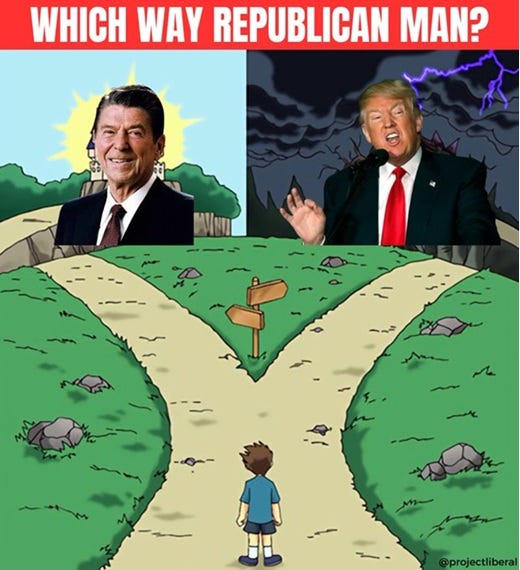
A nice graphics from Project Liberal