

Headline CPI rose 0.1 percent in July, exactly in line with expectations. The year-on-year rate ticked down to 3.4 percent from 3.5 percent. Core CPI — the measure that strips out food and energy — rose 0.2 percent on the month, a touch below the 0.3 percent consensus, and the year-on-year rate eased to 2.5 percent from 2.6 percent.
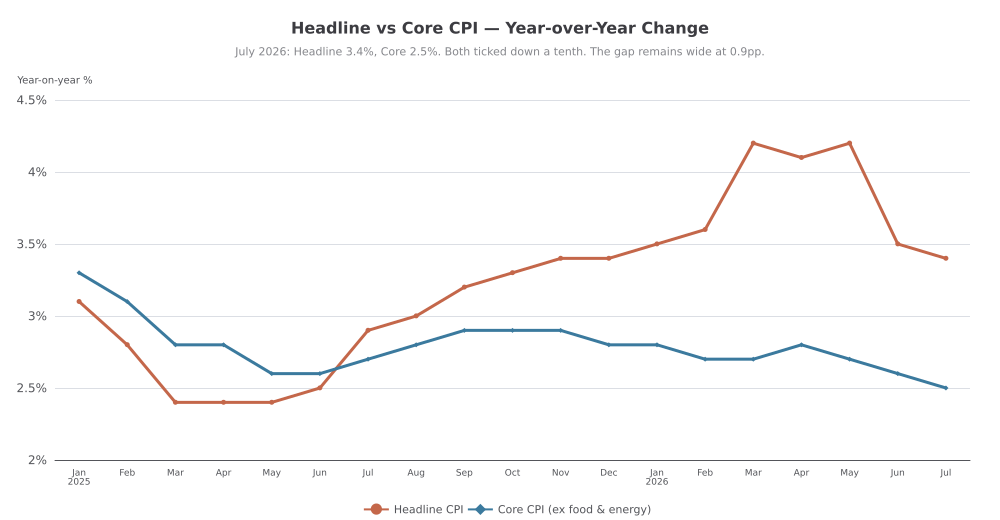
Every line on the chart moved in the right direction. Shelter — the largest component and the one that has kept core stubbornly elevated for two years — rose just 0.1 percent on the month. Energy prices fell 1.5 percent as gasoline dropped 2.9 percent. Food was flat. The details were about as clean as a CPI report gets.
Markets liked it. Rate-hike odds, which had been hovering near 50-50, tilted toward hold. The short end of the curve rallied. The story of the morning was that the Fed could afford to wait.
That story is true, as far as it goes. It is not the whole story. The whole story arrived an hour later, in a separate BLS release that received almost no attention.
The other number
Real average hourly earnings for all employees fell 0.1 percent from June to July. Year-on-year, they fell 0.2 percent. Nominal wage growth — 3.2 percent — is being outrun by headline CPI at 3.4 percent. Workers are losing ground.
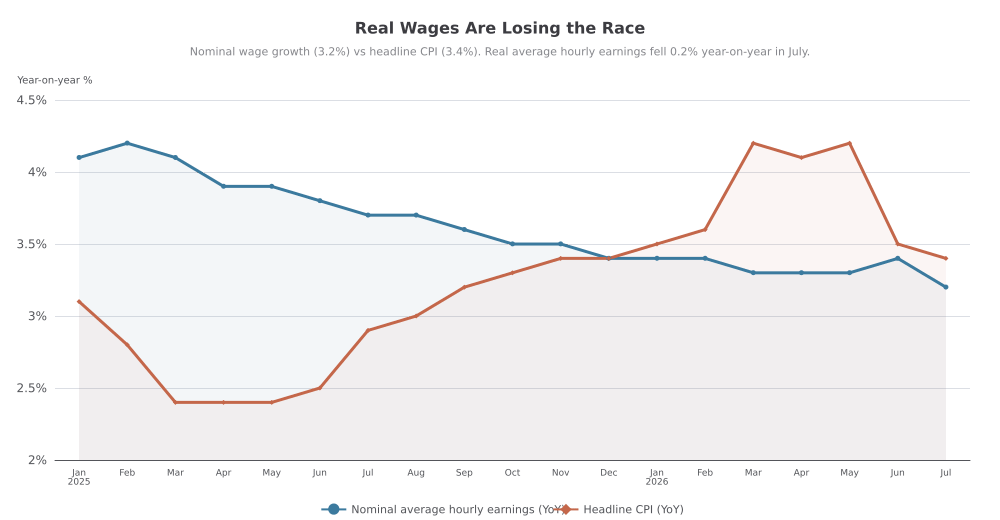
The blue line — nominal wage growth — spent most of 2025 above the red line. That was the post-pandemic catch-up period: labor scarcity gave workers pricing power, and real wages rose even as inflation remained elevated.
The relationship reversed in March 2026, when the energy-driven inflation spike pushed headline CPI above nominal wage growth for the first time in over a year. The gap narrowed in June. It widened again in July. Nominal wage growth is now decelerating — 3.2 percent, down from 3.4 percent in June and 4.2 percent a year ago. Inflation is falling, but wages are falling faster.
This is not the number that a central bank charged with both price stability and maximum employment should be comfortable with. It is a simultaneous deterioration on both halves of the mandate. Prices are still rising faster than the Fed’s target. And workers are losing purchasing power every month.
The gap is still wide
Headline CPI at 3.4 percent and core at 2.5 percent are both above target. The gap between them — 0.9 percentage points — is being driven by energy, where gasoline is up 24.6 percent year-on-year on the back of the US-Iran confrontation. That gap narrowed slightly this month. It could widen again just as quickly.
A ceasefire between Washington and Tehran would bring headline down sharply — perhaps by a full percentage point or more — as the energy component reverses. A further escalation would push headline back toward 4 percent by raising input costs across the entire economy.
Neither outcome is under the Fed’s control. Both would change the inflation picture more than anything the FOMC does with the funds rate. And both would change the real wage picture with it. A ceasefire that brings headline CPI below nominal wage growth would restore positive real wage gains and give households breathing room.
An escalation that pushes headline to 4 percent against wages rising at 3.2 percent would accelerate the erosion. A central bank whose inflation outlook depends on the status of peace talks in the Gulf is not a central bank that has the situation in hand. It is a central bank that is hoping for help it cannot summon.
Core is improving, but the hardest part remains
The softening in shelter is the most meaningful development in this report. Owners’ equivalent rent and rent of primary residence both rose 0.3 percent on the month — still positive, but well below the 0.5 to 0.7 percent readings that prevailed through 2024 and early 2025. Shelter inflation has been the single largest obstacle to getting core back to 2 percent, and it is finally easing.
The offset is in services. Medical care services rose 0.6 percent on the month. Airline fares jumped 2.2 percent. Transportation services were up 0.3 percent.
These are the categories in which wages are the dominant input cost. And here is the bind: wage growth at 3.2 percent is too low to outrun inflation, but still too high — relative to productivity growth — to be consistent with 2 percent core inflation.
The Fed needs wage growth to slow further to bring services inflation down. But workers are already losing ground. Asking them to lose more is not a policy that any central banker will state out loud, even if the arithmetic demands it.
The payroll context
Last week’s jobs report is the other half of this picture. Payrolls fell by 23,000. The prior two months were revised down by 103,000. The participation rate dropped to its lowest in more than five years. The unemployment rate fell only because 264,000 people left the labor force. Temporary layoffs jumped by 153,000.
Combine that with real wages falling and you have an economy in which households are being squeezed from two directions: fewer people working, and those who are working seeing their paychecks lose purchasing power.
The labor market is softening, but not in a way that is bringing inflation down reliably. It is softening in a way that is reducing household welfare without solving the price-level problem. That is the worst possible configuration — for households, for the Fed, and for the bond market.
The Warsh question
This brings the analysis back to the Fed chair. The CPI report was benign enough to take a September rate hike off the table and to give Warsh the room he has been asking for. He does not have to act. He can continue to decline to state a framework, a target, or a reaction function, and point to the data as vindication.
A Fed chair who is relying on falling shelter inflation and a potential Middle East ceasefire to bring inflation back to target is not executing a strategy. He is waiting for help.
A Fed chair who presides over negative real wage growth and calls it a good report has lost the thread on half of his mandate.
The bond market understands both of these things. The long end of the curve remains elevated not because the market expects rate hikes — it no longer does — but because it does not expect the Fed to do what is necessary if the help does not arrive.
The term premium is pricing the absence of a commitment, and a soft CPI print does not restore a commitment. It postpones the moment at which the commitment is tested. The real wage data tells you the cost of postponing.
What to watch
Three things.
First, oil and the Gulf. The single largest determinant of headline CPI — and therefore real wages — over the next three months is whether the US and Iran reach a ceasefire.
A deal would restore positive real wage growth and give the Fed room to hold. A breakdown would push headline back above 4 percent and accelerate the real wage decline, with a labor market that is now demonstrably weakening. That is a stagflationary combination, and the Fed has no framework for it.
Second, shelter and the August CPI. The July shelter reading was encouraging. A second month at 0.1 percent would confirm that the long-awaited disinflation in rents is real. A reversal would suggest July was noise. The August CPI, released on September 10, settles that question.
Third, the August 28 benchmark revision. If it confirms that payroll growth has been systematically overstated, the labor market will look weaker than the headline data have suggested. The Fed will face a choice between easing into sticky inflation or tightening into a softening labor market — with real wages already falling on both paths.
A benign CPI print is better than the alternative. But the headline number is not the whole story, and the hour-later release on real earnings should have been in the lead paragraph, not the footnotes.
Inflation is easing. Workers are still losing. A chairman who treats the first fact as vindication and ignores the second is a chairman who has not told the market — or the country — what he is trying to achieve.
The bill for that omission is being expensed at the long end of the curve, and now, in the real wage data, at the household level as well.
We do not know if wages went backward or not. BLS does not collect wage data, only unit value of remuneration data.