The Aghion-Howitt Model: Creative Destruction Meets Growth Theory
Two of this year´s Economics Nobel recipients

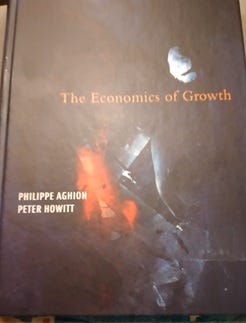
Philippe Aghion and Peter Howitt’s contributions to endogenous growth theory represent one of the most important bridges between Schumpeterian ideas about innovation and modern macroeconomic modeling. Their work, particularly their seminal 1992 Econometrica paper “A Model of Growth Through Creative Destruction,” deserves the Nobel recognition - but like much Nobel-winning economics, it’s worth understanding both what makes it brilliant and where it falls short.
What They Got Right: Endogenizing Innovation
The Core Insight
Before Aghion-Howitt, growth theory had a problem. The Solow model (1956) said long-run growth came from exogenous technological progress—essentially, innovation fell from the sky like manna. Paul Romer’s endogenous growth models (1986, 1990) improved this by making innovation a choice, but treated knowledge as non-rival: one innovation doesn’t prevent another.
Aghion-Howitt’s crucial insight was to take Schumpeter seriously: innovation is a process of creative destruction where new technologies replace old ones. This rivalry creates both:
Incentives for innovation (winner gets monopoly rents)
Incentives against innovation (incumbents want to protect their position)
This dynamic tension - what they call the “replacement effect” versus the “efficiency effect” - generates rich predictions about when innovation accelerates or stalls.
The Mathematical Framework
The Aghion-Howitt model is elegant:
Quality ladders: each innovation improves product quality by a factor λ > 1
R&D investment determines arrival rate of innovations (Poisson process)
Successful innovator gets monopoly power until the next innovation
Creative destruction: old monopolist is replaced
This generates endogenous growth where:
Growth rate depends on R&D intensity
R&D intensity depends on expected profits from innovation
But those profits are limited by threat of being replaced
The model shows that growth can be too fast or too slow relative to a social optimum depending on whether the “business stealing” effect (negative externality) or “knowledge spillover” effect (positive externality) dominates.
Why This Matters for Policy
The Aghion-Howitt framework transformed how economists think about innovation policy:
Competition policy: Too much competition reduces innovation incentives (low profits), but too little competition reduces innovation pressure (incumbents get lazy). There’s an inverted-U relationship - moderate competition is optimal. They and their co-authors demonstrated this empirically.
Patent policy: Strong patents encourage innovation (protect returns) but also entrench incumbents (reduce creative destruction). Optimal patent policy balances these forces and likely varies by sector.
Industrial policy: Government should support entry and competition, not protect incumbents. “Picking winners” fails; “promoting competition among potential winners” succeeds.
Inequality: Their later work shows that growth through creative destruction increases inequality (winner-take-all innovation rents) but also creates social mobility (new innovators replace old). This nuance is often lost in policy debates.
These insights have influenced competition authorities worldwide. The EU’s approach to tech antitrust, debates about patent reform, and discussions of industrial policy all reference this framework.
What Makes It Nobel-Worthy
1. Theoretical Elegance
The model is teachable - it appears in graduate textbooks and can be explained to policymakers. This is harder than it sounds. Many important ideas in economics are either too simple to be interesting or too complex to be useful. Aghion-Howitt hit the sweet spot.
2. Empirical Tractability
Unlike some growth models that generate untestable predictions, the Aghion-Howitt framework produces hypotheses that can be examined with data:
Inverted-U relationship between competition and innovation
Patent citations as measure of creative destruction
Entry/exit dynamics in innovative sectors
Relationship between market structure and R&D intensity
Aghion and co-authors have spent decades testing these predictions, and they largely hold up.
3. Policy Relevance
The model doesn’t just describe the world—it tells policymakers what to do differently. The insight that “competition policy is innovation policy” has influenced real-world antitrust enforcement, particularly in Europe.
4. Intellectual Bridge-Building
Aghion-Howitt connected:
Schumpeter’s verbal insights about creative destruction
With Romer’s endogenous growth framework
And Arrow’s (1962) analysis of innovation incentives
While generating Solow-like steady-state growth
This synthesis brought together previously separate literatures and made Schumpeterian economics rigorous and mathematical.
Where It Falls Short
Now for the critiques - not to diminish their achievement, but because Nobel recognition shouldn’t mean intellectual canonization.
1. The Representative Agent Problem
Despite being about creative destruction - the quintessential story of heterogeneity where new firms replace old - the model still uses representative consumers and simplified firm structures.
Real innovation involves:
Entrepreneurs with different abilities and motivations
Firms with different organizational structures
Workers with different skills affected differently by innovation
Geographic clustering and local spillovers
The model abstracts from all this heterogeneity to get tractable math. That’s defensible for some questions, but it means the model can’t speak to distributional issues, regional inequality, or why some places innovate and others don’t.
2. Innovation as R&D Expenditure
In the model, innovation is a function of R&D spending - more money leads to higher probability of innovation. But real innovation involves:
Organizational capabilities
Tacit knowledge and learning-by-doing
Fortunate discoveries by accident
Recombination of existing ideas in new ways
User innovation
Reducing this to “R&D expenditure” misses much of what makes innovation interesting. It’s like modeling artistic creativity as “hours spent painting.”
3. The Financial Sector Is Missing
Innovation requires financing, but the Aghion-Howitt model has no financial sector. Who funds the R&D? How do financial market imperfections affect innovation?
In reality:
Startups face credit constraints
Venture Capital funding creates distortions (focus on exits, not long-term value)
Public markets often undervalue innovation
Financial crises destroy innovative capacity
Their later work (more on that below) addresses some of this, but the core model treats financing as a non-issue. Given 2008 and the subsequent innovation slowdown, this seems like a major omission.
4. Growth Accounting Doesn’t Work This Way
The model predicts growth comes from quality improvements (λ^n, where n is a number>1, of innovations). But growth accounting suggests most growth comes from:
Capital deepening (more capital per worker)
Factor reallocation (resources moving to more productive uses)
Incremental improvements, not discrete jumps
A&H´s “quality ladder” metaphor is appealing but doesn’t match how most productivity growth actually happens.
5. Political Economy Is Assumed Away
The model assumes:
Governments can implement optimal policy
Incumbents don’t capture regulators
Patent systems can be designed efficiently
Competition policy isn’t subject to political pressure
But in reality:
Incumbents lobby for protection
Patent systems serve lawyers more than inventors
Antitrust enforcement is highly politicized
Industrial policy usually means subsidizing politically connected firms
The model tells us what optimal policy would be if implemented by benevolent technocrats. It doesn’t tell us how to get to optimal policy when incumbents have political power.
6. The Great Stagnation Problem
If the Aghion-Howitt model is correct, why has productivity growth slowed since the mid-1970s despite:
Massive increases in R&D spending
More scientists and engineers than ever
Better communication and knowledge sharing
Stronger intellectual property protection
Possible answers (not in the model):
We’ve picked the low-hanging fruit
Measurement problems (digital innovation isn’t captured)
Regulatory burden has increased
Innovation is harder in mature economies
Ideas are getting harder to find (Bloom et al.)
What the Nobel Committee Got Right
The decision to honor Aghion and Howitt (along with Acemoglu (2024) for related work on institutions and growth) signals several things:
1. Growth theory still matters: Despite the profession’s focus on business cycles post-2008, long-run growth remains the fundamental question for human welfare.
2. Schumpeter was right: Creative destruction is central to understanding capitalism, and bringing his insights into formal models was important intellectual work.
3. Theory can inform policy: The Aghion-Howitt framework actually influenced competition and innovation policy, showing that good theory can matter beyond academic journals.
4. Empirical work matters: Unlike some theorists, Aghion spent decades testing his models with real data. The Nobel rewards this combination of theory and evidence.
The Work That Deserves More Attention
While the 1992 creative destruction paper is the famous one, some of Aghion’s and Howitt´s (with others) later work is more interesting:
“Competition and Innovation: An Inverted-U Relationship” (2005): Shows empirically that moderate competition maximizes innovation. Simple idea, but hard to prove and policy-relevant.
“The Effect of Entry on Incumbent Innovation and Productivity” (2009): Demonstrates that threat of entry spurs innovation by incumbents - validates the creative destruction mechanism.
This later work is less mathematically elegant but more realistic and policy-relevant.
What This Means Going Forward
The Aghion-Howitt Nobel might signal several things about where growth economics is heading:
1. Back to Schumpeter: After decades of focusing on steady-state growth, the profession is rediscovering that disruption, entry, exit, and creative destruction matter more than smooth accumulation.
2. Competition policy as growth policy: Expect more work on how antitrust enforcement affects innovation, especially regarding big tech platforms.
3. Geography of innovation: Why does innovation cluster? What institutions encourage it? This is implicit in Aghion-Howitt but needs development.
4. AI and automation: How does the Aghion-Howitt framework apply when “innovation” means replacing humans with machines rather than replacing old machines with new ones?
5. Climate and green growth: Can we have creative destruction in energy systems fast enough to avoid climate catastrophe? What policies would accelerate it?
These are the questions where the Aghion-Howitt framework is most useful - and where its limitations will become most apparent.
Final Assessment
Philippe Aghion and Peter Howitt deserve the Nobel. They took Schumpeter’s brilliant but vague ideas about creative destruction and made them rigorous, testable, and policy-relevant. They influenced how we think about competition, innovation, patents, and growth. Their work is teachable, empirically supported, and intellectually important.
So: celebrate the Nobel, learn from the model, apply it to policy questions where it’s relevant. But also remember that innovation is messier, more political, more institutional, more historical, and more human than any mathematical model can capture.
That’s not a criticism of Aghion and Howitt - it’s a reminder that even Nobel-worthy economics is just one tool in the toolbox, not the whole toolbox itself.
The creative destruction they modeled so elegantly should apply to their own model too: let new approaches build on it, improve it, and eventually replace it. That would be the most Schumpeterian tribute of all.