Not All Wars Are Created Equal
Why the Gulf Changes Everything and Yugoslavia Changed Almost Nothing

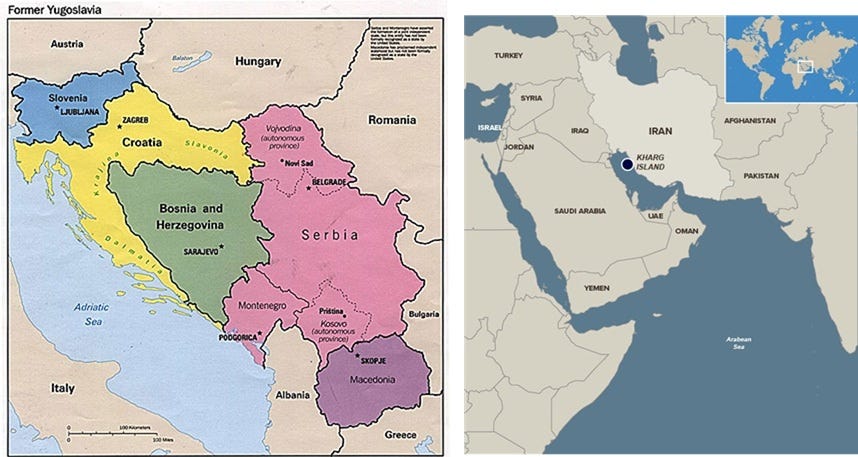
When the Socialist Federal Republic of Yugoslavia began its violent disintegration in 1991, the world watched a human catastrophe unfold in slow motion at the edge of Europe.
The wars in Slovenia, Croatia, Bosnia, and Kosovo killed hundreds of thousands of people. They produced the worst atrocities on European soil since the Second World War. They gave the world the word “ethnic cleansing” as a bureaucratic euphemism for something ancient and barbaric.
They tested NATO’s post-Cold War identity, strained transatlantic relationships, and eventually drew American military power into a conflict it had spent years trying to avoid.
And yet, when the guns finally fell silent — when Dayton (General Framework Agreement for Peace in Bosnia and Herzegovina) was signed, when Kosovo was placed under UN administration, when the last warlord was hauled before the International Criminal Tribunal in The Hague — the world economy continued more or less as before.
Your gas prices did not spike. Your grocery bill did not change. The factories in Germany kept running. The container ships kept sailing. The dollar remained the world’s reserve currency, and the architecture of global finance sat undisturbed.
Contrast that with eighteen days of war in the Persian Gulf in 2026, and the difference is not one of degree. It is one of kind.
The Accident of Geography
To understand why some conflicts reshape the world and others do not, you have to start not with ideology or military power but with geography — specifically, with what sits beneath the ground and how it gets from there to the engine of a car, a factory floor, a power grid or a farm.
Yugoslavia sat at a strategic crossroads in the Balkan peninsula. It controlled no critical maritime chokepoints. It produced no commodity that the world could not acquire elsewhere. Its rivers fed the Danube, not the arteries of global trade. Its mountains were important to the people who lived among them, and to the military planners trying to insert troops into them, but they were irrelevant to the price of steel in Shanghai or the cost of heating oil in Boston.
The Persian Gulf is something else entirely. Roughly twenty percent of the world’s oil — and a significant share of its liquefied natural gas — transits through the Strait of Hormuz, a narrow passage between Iran and Oman that is, at its most constricted, about twenty-one miles wide.
The Gulf states sitting on either side of that passage — Saudi Arabia, Iraq, Iran, Kuwait, the UAE, Qatar — collectively hold a majority of the world’s proven oil reserves.
The Strait of Hormuz is not merely a geographic feature. It is the circulatory system of the industrial world. When it closes, or even when it becomes unreliable, the effects are not regional. They are immediate, global, and structural.
This is the foundational asymmetry. Yugoslavia’s geography made it a humanitarian emergency and a test of European security architecture. The Gulf’s geography makes every serious conflict there a potential civilizational stress test.
Oil Is Not Just Energy
The second asymmetry is subtler but equally important, and it is consistently underappreciated by people who think of oil primarily as a fuel source.
Oil is the foundation of the dollar’s global dominance. It is the reason that central banks from Beijing to Brasília hold dollar reserves. It is the mechanism by which the United States has been able, for more than fifty years, to borrow cheaply, run large deficits, and project financial power far beyond what its domestic economy alone would justify.
The petrodollar system — born from Nixon’s abandonment of the gold standard and formalized in the 1974 agreement with Saudi Arabia — created a self-reinforcing loop: oil is priced in dollars, so every nation that needs oil needs dollars, so every nation accumulates dollar reserves, so the dollar remains the world’s indispensable currency, so America retains extraordinary financial privileges that compound over time.
Yugoslavia had nothing to do with any of this. Its wars were fought over ethnicity, religion, memory, and land. They were genuinely tragic. But they posed no threat to the plumbing of global finance. No currency arrangement was at stake. No commodity pricing system hung in the balance. The drachma, the deutschmark, and the franc were unaffected. The bond between oil and dollar — the silent engine of American economic hegemony — was never in play.
Gulf conflicts, by contrast, have always carried this latent financial dimension. The 1973 Arab oil embargo didn’t just raise gas prices; it shattered the postwar confidence in cheap energy that had underwritten Western prosperity for two decades and triggered the worst recession since the 1930s.
The 1979 Iranian Revolution removed Iranian oil from global markets and sent prices to levels that induced double-digit inflation across the developed world. The first Gulf War in 1991 — fought simultaneously with the early stages of Yugoslav disintegration — was predicated explicitly on preventing a hostile power from controlling a disproportionate share of global oil supply.
When James Baker, then Secretary of State, was asked what that war was really about, he said, without embarrassment: “Jobs.” He meant petrodollars. He meant the global economy. He was right.
The Proxy Dimension
There is a third asymmetry, which has to do with the web of external interests that attach themselves to Gulf conflicts in a way that has no real parallel in the Balkans.
Yugoslavia’s wars did eventually draw in external powers, but those interventions were essentially humanitarian and stabilizing in intent — or, in the case of Russian sympathy for the Serbs, expressions of Orthodox and Slavic solidarity that carried real emotional weight but limited material consequence.
No great power’s core economic interests were threatened by the outcome in Sarajevo. No superpower’s global financial architecture was at stake in Srebrenica.
The Gulf is criss-crossed with the vital interests of every major power on earth simultaneously.
China gets roughly half of its oil from the Middle East and has spent twenty years building infrastructure, investment relationships, and diplomatic presence throughout the region.
Russia has used Gulf oil market dynamics as an instrument of foreign policy, coordinating with Saudi Arabia through OPEC+ to manage prices in ways that serve Moscow’s budget and its geopolitical leverage over energy-dependent European nations.
India, Japan, and South Korea are all critically dependent on Gulf energy and maintain careful, sometimes contradictory relationships with the various regional powers.
Europe’s energy vulnerability — exposed so nakedly by the Ukraine war — runs through the Gulf as surely as it runs through Russia’s pipelines.
This means that a serious Gulf conflict does not stay regional. It immediately activates the nervous systems of every major economy.
It forces governments in Tokyo, Seoul, New Delhi, Berlin, and Beijing to make rapid calculations about energy security, alliance obligations, and economic survival that have no equivalent in any Balkan scenario. The Yugoslavia wars produced diplomatic crises within NATO. Gulf wars restructure the global economy.
Escalation Ladders and Nuclear Shadows
The fourth asymmetry is the most alarming: the escalation dynamics are categorically different.
Yugoslavia’s wars, for all their horror, had a natural ceiling. None of the parties possessed nuclear weapons. None controlled assets whose destruction would trigger cascading global consequences.
The worst conceivable outcome — the wars spreading beyond the former Yugoslav borders into a wider Balkan conflagration — would have been a serious regional crisis but not an existential one. NATO’s eventual intervention was possible precisely because the escalation risks were manageable.
The Gulf sits under a very different shadow. Iran has been pursuing nuclear capability for decades. Israel possesses nuclear weapons and has always reserved the right to use them to prevent an existential threat. Saudi Arabia has stated publicly that it will seek nuclear capability if Iran achieves it. Pakistan, a nuclear-armed state with deep ties to the Gulf, watches these developments with acute attention.
Any Gulf conflict that crosses certain thresholds — the destruction of a state, the collapse of a regime, the dispersal of fissile material — runs along an escalation ladder whose upper rungs lead somewhere that no Balkan conflict ever approached.
This is not hypothetical. The 2026 war has already raised serious concerns about the disposition of Iran’s nuclear stockpile in the event of regime collapse. The scenario in which fissile material ends up in the hands of non-state actors, or in which a cornered regime makes a final desperate calculation, cannot be dismissed as fantasy. It is a low-probability but civilization-scale risk that simply did not exist in the Yugoslav theater.
What Yugoslavia Actually Was
It is worth being precise about what the Yugoslav wars were, because the contrast illuminates rather than diminishes their tragedy.
They were, at their core, the violent resolution of a question that most of Europe had resolved peacefully or not at all: what happens when a multinational state built on ideology rather than ethnicity loses the ideology?
Yugoslavia was held together by Tito, by the idea of a third way between East and West, and by the mutual deterrence of its constituent ethnic communities. When all three dissolved simultaneously, the result was a contest over land, identity, and historical grievance that had been suppressed for decades.
The international community’s engagement with Yugoslavia was fundamentally about norms — about whether ethnic cleansing would be tolerated in post-Cold War Europe, about whether NATO had a purpose beyond collective defense against a Soviet threat that no longer existed, about whether the international community had any obligation to intervene in sovereign states committing atrocities against their own populations.
These were important questions, and the answers reached at Dayton and in Kosovo set precedents that shaped international law and institutional behavior for a generation.
But they were questions about norms, not about resources. About identity, not about the infrastructure of the global economy. About the rules of war, not about the rules of trade.
The Differential Weight of Consequences
The distinction I am drawing is not a moral one. The suffering in Sarajevo was no less real than the suffering in Tehran or Baghdad. The children who died in Srebrenica were no less deserving of the world’s grief than the children who die in any Gulf city under bombardment. Human suffering does not rank itself by strategic importance.
But geopolitical consequences do rank themselves, and the ranking is determined not by moral weight but by material reality — by where the oil is, by how the currency system works, by which waterways carry what share of the world’s commerce, and by which conflicts carry the potential to restructure the financial and physical infrastructure on which eight billion people depend.
The Yugoslav wars ended. The borders were redrawn, imperfectly. The tribunals ground forward, slowly. The region stabilized, unevenly. The world moved on, essentially intact.
Gulf conflicts do not permit that kind of moving on. Their consequences embed themselves in energy prices, in currency arrangements, in supply chain decisions, in the strategic calculations of every major power simultaneously.
They set precedents not just for how wars are fought but for how the global economy is organized — for who prices what in which currency, for which chokepoints are secure and which are not, for whether the architecture of American financial hegemony that has governed the world since 1974 continues to hold.
That is the difference. Not in the blood spilled — which is always terrible — but in what is at stake beyond the battlefield. In the Balkans, the answer was justice, norms, and regional stability. In the Gulf, the answer is everything else.
Bottom Line: Trump and his sycophants were only concerned with the bombing stage. “Everything else” was of no concern.
Over done The war is different from Yugoslavia but Gulf oil in not the basis of dollar as the world’s medium of exchange nor e the reason NYC is the hub o global investment.
Oil shocks cause smart central banks to inflate and they may inflate too much but central banks, not oil are the authors of inflation.