Mouths and Minds
The world holds four times as many people as it did a century ago and a fraction of the poverty. That inverts the Malthusian prediction exactly — and the reason is the one variable Malthus left out.

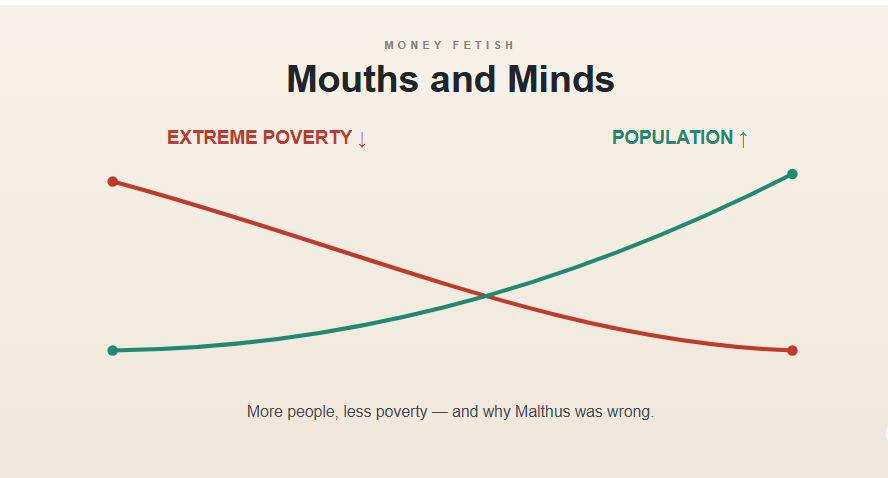
Put the two charts side by side and the story tells itself.
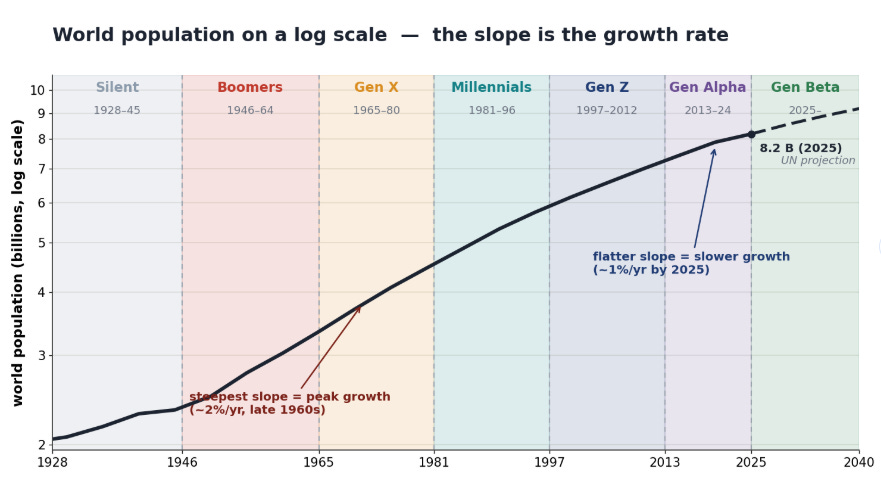
[CHART 1 — world population by generation: ~2 billion in 1928 to 8.2 billion in 2025.]
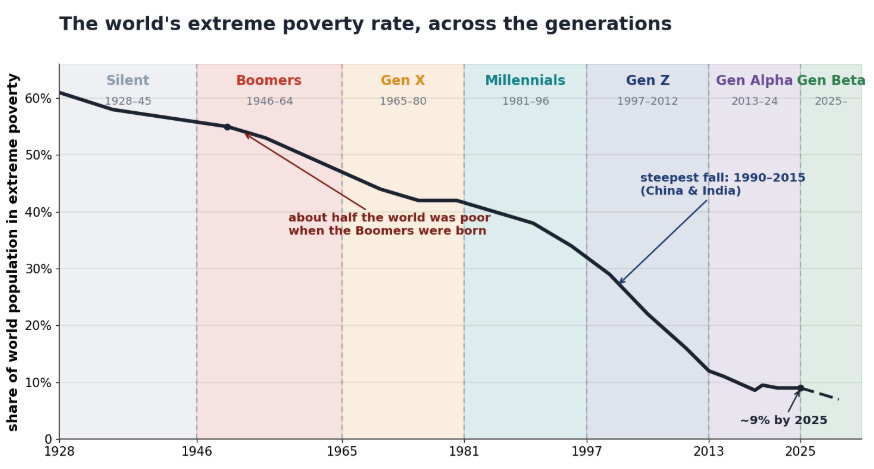
[CHART 2 — the world’s extreme poverty rate by generation: roughly 55% in 1950 to about 9% in 2025.]
One line goes up by a factor of four. The other falls to a sixth of where it started. The most crowded world in human history is also the least poor one it has ever been. And the two facts are not unrelated bystanders — they are the precise pair that Thomas Malthus said could not occur together.
What Malthus actually claimed
It is worth stating his argument at full strength, because it was not foolish. In his 1798 Essay on the Principle of Population, Malthus argued that population, when unchecked, grows geometrically — 2, 4, 8, 16 — while the food supply grows at best arithmetically — 2, 3, 4, 5. Two curves with those shapes can only end one way.
Population runs ahead of subsistence, and the gap is closed by misery: famine, disease, and war raising the death rate, or moral restraint lowering the birth rate.
Either way, the mass of humanity is pinned to the edge of subsistence. Any gain in income is spent on extra surviving children, which enlarges the population, which pushes income per head back down to where it started.
The cruel core of the model is the link it asserts: more prosperity means more people, and more people means a return to poverty. Living standards cannot rise for long, because the prize for any improvement is a bigger population eating it back down.
Here is the part usually skipped. For almost the whole of human history, Malthus was right. Gregory Clark’s work on pre-industrial living standards shows roughly flat real incomes for millennia — a peasant in 1800 was no better off than one in 1500 or in ancient Rome.
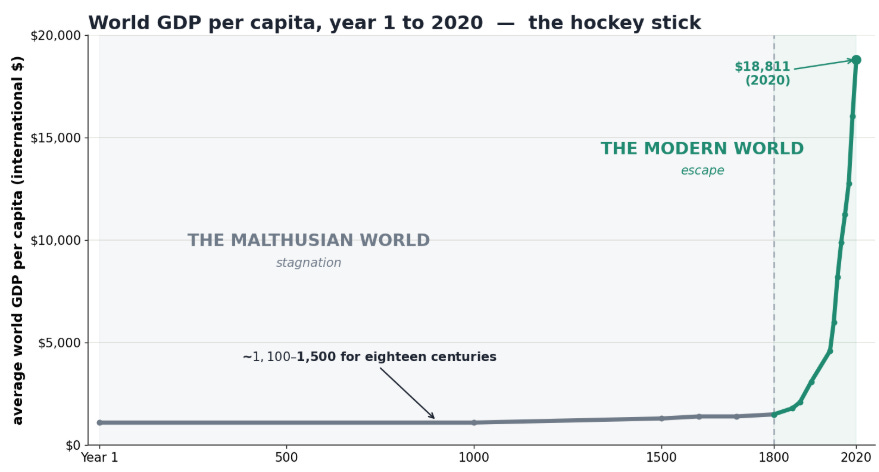
Good harvests and new land raised the population, not the standard of living. Malthus described that world accurately. His error was one of timing. He published (1798) at the exact point where history broke, just as the trap was about to spring open, and he mistook the rule of the past for a law of the future.
The reversal in the data
What happened next is the two charts at the top. Since Malthus wrote, the world’s population has gone from under one billion to more than eight. On a strict reading of his model, that should have produced ever-deepening misery.
Instead, the share of humanity in extreme poverty fell from around 80% two centuries ago to about 55% by 1950 and to roughly 9% today.
The level chart and the poverty chart move in opposite directions. That is the whole refutation in one image. Malthus predicted they would move together, upward.
And the inversion is sharper than the rate alone suggests. Because the rate fell while the base exploded, the absolute number of people in extreme poverty also fell — from roughly two billion around 1990 to about 800 million now.
The world added billions of people and subtracted more than a billion of the poor at the same time. There is no version of the Malthusian model that survives contact with that fact.
Why he was wrong: the factors behind the result
Four forces broke the trap, and a fifth explains the steep final drop.
Food stopped growing arithmetically. Malthus’s central assumption was that the food supply could only crawl upward. Sustained technical progress turned that crawl into a sprint.
Mechanization, new crop varieties, and above all chemistry rewrote the limit. The Haber-Bosch process, which pulls nitrogen fertilizer out of the air, is by some estimates responsible for feeding close to half the people alive.
The Green Revolution of the mid-twentieth century — Norman Borlaug’s high-yield grains — multiplied cereal output across the poor world. Food began growing geometrically too, and faster than population. The arithmetic curve Malthus drew was never a law of nature; it was a snapshot of agriculture before science reached it.
Prosperity turned out to lower the birth rate, not raise it. This is the deepest break, because it overturns the behavioral assumption at the heart of the model.
Malthus assumed richer people have more surviving children, forever. The opposite is true past a point. As incomes rise, child mortality falls, people move to cities, and women gain education and options, the birth rate drops — the demographic transition.
The global fertility rate has fallen from over five children per woman in the 1960s to about 2.3 today. The log-scale view of the population chart shows the consequence directly: the slope, which is the growth rate, peaked around the late 1960s and has been flattening ever since. The feedback loop Malthus feared — wealth breeding population breeding poverty — runs backwards. Development brings fewer births, not more.
People are producers, not only mouths. Malthus counted humans on one side of the ledger, as consumers of a fixed larder. He missed that each person is also a mind, and minds make the larder bigger.
Ideas, unlike land, are non-rival — once discovered, a better seed or a vaccine or a process can be used by everyone at once, and it does not run out. A larger population is therefore a larger stock of potential inventors, and historically more people has meant faster technological progress, not slower.
This is the thread running from Ester Boserup, who showed that population pressure induces agricultural innovation, through Julian Simon’s argument that human ingenuity is the “ultimate resource,” to the modern growth theory of Paul Romer and the long-run evidence assembled by Michael Kremer. Malthus modeled humanity as livestock. The error was leaving out the part of a person that has ideas.
Markets turned scarcity into substitution. When a resource grows scarce, its price rises, and the rising price does two things Malthus’s model had no room for: it rations demand and it rewards anyone who finds a substitute or a cheaper way to produce.
Scarcity, in a market, finances its own cure. Julian Simon bet Paul Ehrlich in 1980 that the real prices of five metals would fall over the next decade despite population growth. They fell. The point was not luck; it was that human response to scarcity expands the effective supply faster than population draws it down.
And the final collapse had names: China and India. The steepest fall in the poverty chart, from about 1990 to 2015, was not a gentle global drift. It was driven by a handful of countries opening to markets and trade — China after 1978, India after 1991 — and industrializing at speed.
Those two countries alone moved on the order of a billion people out of extreme poverty in a generation. The mechanism was economic growth, the thing Malthus said could not be sustained per head, working through reform, trade, and the diffusion of technology.
What he got right, and what is still open
A fair verdict does not stop at “Malthus was wrong.” He was wrong about the future and right about the past, and the distinction matters.
The trap was real for almost all of human history; the escape is recent and is not guaranteed to be permanent.
Where growth and the demographic transition have not yet arrived, Malthusian arithmetic still bites. In much of Sub-Saharan Africa, high fertility on top of weak growth has meant that the number of people in extreme poverty has risen even as the global rate fell — the old logic, still running, in the places the escape hasn’t reached.
The twentieth-century heirs of Malthus repeated his mistake on schedule. Paul Ehrlich’s Population Bomb in 1968 and the Club of Rome’s Limits to Growth in 1972 forecast mass famine and collapse from population pressure, and the famines did not come; the same missing variable — human ingenuity responding to scarcity — defeated them as it had defeated him.
But discrediting the population-to-poverty link is not the same as proving there are no limits at all. The charts settle one question: more people did not mean more poverty; in fact, it coincided with far less.
They do not settle whether the planet’s sinks — the climate, the oceans, biodiversity — can absorb what eight billion increasingly rich people do to them. That is a real constraint, and it is a different argument from the one Malthus lost. The optimism the charts earn is specific: human numbers are not the enemy of human welfare. However, it is not a blanket permission slip.
The escape was political
Notice which of the five forces did the work, because it changes how safe the result is.
Two of them are close to automatic. Technology advances whether or not anyone roots for it, and the demographic transition, once a country starts down it, rarely reverses — fertility keeps falling as people grow richer and cities fill. Those two will keep grinding in almost any future.
The other three are choices. Growth, open markets, and the integration that let China and India industrialize were not laws of physics. They were built — by policy, by institutions, by a postwar order that kept trade open and money roughly stable. The steepest drop in the poverty chart was the dividend of a political arrangement. And political arrangements can be taken apart.
Three are being taken apart now.
The first is fiscal. Public debt is rising across the rich world and much of the poor world, toward levels that, on current paths, crowd out the productive spending — infrastructure, research, schooling — that growth runs on, and that tempt governments toward the quiet default of inflation in place of the visible one of restructuring.
A world of fiscal dominance is a world of higher capital costs and less stable money, and both land hardest on the poor countries that still have to borrow to grow. Growth is the engine of poverty reduction; debt service is increasingly its rival for the fuel.
The second is political. The country that anchored the open order — the United States — has become a source of policy that is erratic rather than stabilizing, and it is not alone in its dysfunction.
When the rule-setter stops keeping the rules, the predictability that long-horizon investment depends on erodes everywhere. Institutions are what turn good ideas into rising incomes; disorder at the center degrades them at the edges.
The third is the unwinding of integration itself — the force that did the most recent work.
Tariff walls are going back up, supply chains are fragmenting into rival blocs, and the trading system that let poor countries grow by selling to rich ones is being pulled apart.
This matters most for the people the chart has not yet reached. The escape route that worked for East Asia, then China, then India — export-led industrialization into an open world — is the route now being closed, just as Sub-Saharan Africa, where the number of poor is still rising, lines up to use it.
Here is the uncomfortable symmetry. Malthus was beaten by growth and openness. Both are political achievements, and political achievements can be undone by politics.
The danger ahead is not that he was secretly right about population. It is that a world of mounting debt, failing governance, and rising walls could produce his outcome by another route — misery returning not because there are too many people, but because we choked the growth and the integration that proved him wrong. A Malthusian result without the Malthusian mechanism. A trap rebuilt by hand.
None of this is fated. The deep drivers are strong, a fragmenting world still innovates, and a productivity jump from some yet unkown source could swamp the friction.
The poverty line in the chart may keep falling, only more slowly, and reach near zero anyway. But the last stretch — the hardest billion, in the worst-governed and least-integrated places — is exactly where growth, stable money, and open markets matter most, and exactly where all three are now in doubt. The first forty-six points of the fall were earned. The last nine are not promised.
The verdict
The pessimism failed because it rested on a single category error. Malthus, and every neo-Malthusian after him, treated a human being as a stomach — a claim on a fixed supply of food. The two charts are what happens when you remember that a human being is also a head — a source of the ideas that keep enlarging the supply.
The most populous generation that has ever lived is also the least poor. Those two charts, read together, are the empirical headstone of a theory that could not imagine people producing more than they consume.
Whether the next generation gets to write the same story is not a question of arithmetic. It is a question of whether the growth, the openness, and the stable money that did the work survive the politics now turning against them — which is to say it is, as it always was, a choice.
"They do not settle whether the planet’s sinks — the climate, the oceans, biodiversity — can absorb what eight billion increasingly rich people do to them. That is a real constraint, and it is a different argument from the one Malthus lost."
You seem to be at least trying to give a fair shake to the idea that there are real risks associated with growth, but I don't think it's right. One, I'm not sure 'sinks' is the right term for those three, definitely not biodiversity, which is a stock. Also, you say the charts do not settle this particular question. You're right, they do not. But we have enormous evidence that this question is essentially settled, and the answer is not good. Innovation has enabled massive gains in food production and energy (which is another strange omission from your analysis). Whether new innovations can reverse these other biophysical limits is an open question, and not one with a lot of precedent. Right now it's not looking very good. Entropy is not on our side here. It's much easier to extinct species than it is to resurrect them. It's much easier to carbonize than to extract, or to acidify than de-acidify. And all of this completely ignores animal welfare as well.
And finally, you say Malthus lost this argument, as if these boundaries are completely unrelated to the core argument. If you want to be really narrow and limit the argument to food and water, sure. But in general it's about carrying capacity based on population and behavior bumping up against biophysical constraints, and these that you mention are just different constraints in the same general vein.