Manufactured Victory
Reading the National Review’s Iran War Optimism Through the Crisis-Creator Lens

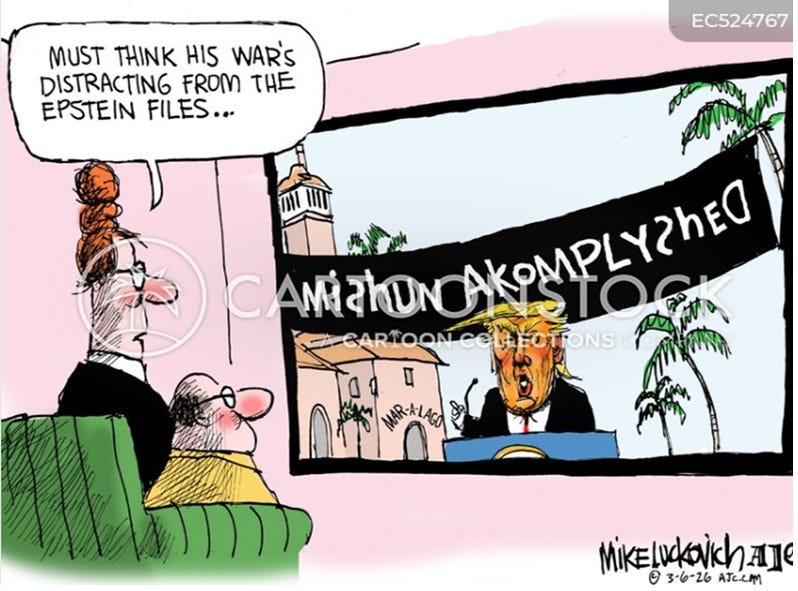
There is a particular kind of journalism that functions not as analysis but as permission — permission for readers who want to feel good about something uncomfortable to do so with the appearance of intellectual cover.
The National Review’s piece on Iran war successes that the media supposedly doesn’t want you to hear about belongs to this genre, and understanding why requires reading it not on its own terms but through the framework that this 2018 Atlantic article established with such clarity:
Donald Trump does not stumble into crises. He manufactures them. And once manufactured, he requires allies in the media ecosystem to declare them resolved.
The NR headline alone — “The Iran War Successes They Don’t Want You to Hear About” — is doing more ideological work than its author may realise.
The “they” is doing what it always does in this construction: it pre-emptively delegitimises scepticism by framing it as suppression rather than analysis. If you question the successes, you are one of “them.”
This is not a rhetorical flourish. It is a structural feature of the crisis-manufacture cycle as the Atlantic 2018 piece identified it.
Once a crisis has been created and partially managed, the next move is always to declare victory and discredit anyone who points out that the victory is incomplete, contested, or illusory. The National Review article is performing that function.
Let us grant what is genuinely true. The tactical military achievements in the early weeks of the Iran war are real and have been confirmed by sources that have no incentive to flatter the administration. The opening strikes killed Khamenei and dismantled significant portions of Iran’s air defence and missile infrastructure. American and Israeli forces established air superiority quickly.
These are not trivial accomplishments and dismissing them entirely would itself be a form of motivated reasoning. Any serious assessment has to start by acknowledging them.
But here is precisely where the crisis-creator framework becomes analytically essential, because it reveals what the National Review article is designed to obscure.
The question is not whether tactical successes occurred. The question is what they were in service of, and whether the goals themselves were clearly defined, legitimately authorised, and strategically coherent.
On all three counts, the record is troubling in ways that no amount of battlefield achievement can resolve.
Start with the question of authorisation. Trump launched what is, by any standard legal definition, a war — a sustained military campaign against a sovereign nation’s government, military infrastructure, and leadership — without a congressional declaration of war and without requesting an authorisation for use of military force.
He briefed the Gang of Eight (the Speaker of the House, the House Minority Leader, the Senate Majority Leader, the Senate Minority Leader, and the chairs and ranking members of both the House and Senate Intelligence Committees. In practice this means four Republicans and four Democrats at any given time, reflecting the bipartisan intent of the arrangement) before the strikes began, and according to reporting, misled them about the scope of what was planned. This is not a procedural quibble. It is a constitutional question of the first order.
The Atlantic piece from 2018 diagnosed Trump’s preference for acting before institutional constraints could engage — “You can just do things” — and the Iran war is the most consequential application of that philosophy yet attempted.
The National Review article, focused on celebrating battlefield outcomes, treats this constitutional rupture as irrelevant. It is not. A democracy that allows its executive to launch major wars unilaterally, and then validates that choice by pointing to early military success, has conceded something it cannot easily recover.
Then there is the question of strategic coherence, which is where the crisis-creator framework cuts deepest.
Throughout the first weeks of the war, Trump and his administration offered shifting, sometimes contradictory accounts of what the objectives were. On one day he declared Iran essentially defeated; on another he said the war would not end that week but “very soon”; on another he added new objectives; on another he threatened to strike civilian infrastructure before pulling back.
These are not the communications of a commander with a clear strategic vision managing expectations. They are the communications of a crisis manufacturer managing attention — keeping the story moving, preventing any fixed point from which accountability could be applied, ensuring that the definition of success remained elastic enough to be claimed regardless of outcome.
This matters enormously for evaluating the National Review piece, because the “successes” it describes are tactical achievements measured against no clearly articulated strategic standard.
The Brookings analysts put it with precision: operational success does not necessarily translate into strategic success. The IRGC remains intact as an institution. Iran has selected a new supreme leader. Iranian attacks against Gulf neighbours have continued.
When the National Review catalogues what has been accomplished on the battlefield, it is implicitly measuring achievement against a standard — the destruction of Iran’s military capacity — that was only one of several shifting objectives, and arguably the least strategically decisive one.
The 2018 Atlantic piece identified something that is directly applicable here: Trump “successfully bullied NFL owners into a defensive position” and declared victory on the anthem controversy, but he did not actually change hearts and minds. He is, the article noted, “not especially good at changing hearts and minds.”
The Iran war exhibits the same structural pattern at catastrophic scale. Whatever military damage has been inflicted, the fundamental strategic question — what happens next in Iran, who governs, whether the regime’s replacement will be more or less dangerous to American interests — remains entirely unresolved.
The National Review article treats the absence of that resolution as outside its scope. But it is precisely the scope that matters.
There is also a more uncomfortable dimension to this story that the crisis-creator lens illuminates.
The 2018 Atlantic piece made the observation that Trump manufactured a sense of immigration crisis even when quantitative data showed no objective crisis existed.
He did so because crisis was politically necessary — it bound his supporters to him, it drew attention away from his governance failures, and it allowed him to present himself as the only figure capable of resolving the emergency he had created.
The Iran war has the same fingerprints. It was launched at a moment when Trump’s domestic political position was complicated, when his trade war was generating economic anxiety, when the Iran war could serve as a vehicle for projecting strength and decisiveness regardless of strategic outcome.
The war’s utility as a crisis-management tool does not mean it was launched solely for that reason. But it would be naive, given everything we know about how this presidency operates, to treat it as irrelevant.
What the National Review article ultimately offers is a service that every crisis requires once it reaches the declaration-of-victory phase: the intellectual architecture of closure.
The crises that Trump manufactures follow a predictable cycle — provocation, escalation, near-overreach, managed retreat, and then the claim of success.
The media allies who perform the last stage of this cycle are not lying, exactly. The successes they cite are usually real, as far as they go.
What they are doing is something more subtle: presenting partial tactical achievement as strategic vindication, and framing anyone who asks the harder questions as a member of the suppressive “they” who doesn’t want the truth heard. It is, in this sense, the most sophisticated part of the cycle — because it uses genuine facts to foreclose the genuine questions.
An honest accounting would acknowledge the real military accomplishments, hold them alongside the unresolved strategic questions, the constitutional breach, the civilian casualties, the economic disruption, the shifting objectives, and the Iranian regime’s demonstrated resilience, and resist the temptation to grade on a curve calibrated to expectations that were themselves set by the crisis manufacturer.
That is harder to write and less satisfying to read. It is also, at this particular moment in American political life, exactly the kind of analysis that is most needed and most scarce.