Cochrane’s Bus
John Cochrane has a new post on whether Warsh should raise rates, and its central claim is one I largely accept: there is nothing mechanical about higher interest rates lowering inflation.

Where we part is on what follows from that — and on the one paragraph where he praises the thing I have spent three posts attacking.

Cochrane’s post is built around a single simulation, and it is worth stating his argument before going anywhere near a disagreement, because it is the most interesting thing published on the Fed this week.
Raise the interest rate and hold it there. In the short run inflation falls, exactly as the conventional story says and as 1980 to 1982 appears to confirm. Then inflation turns around and rises. In the long run a higher nominal interest rate goes with higher inflation, not lower.
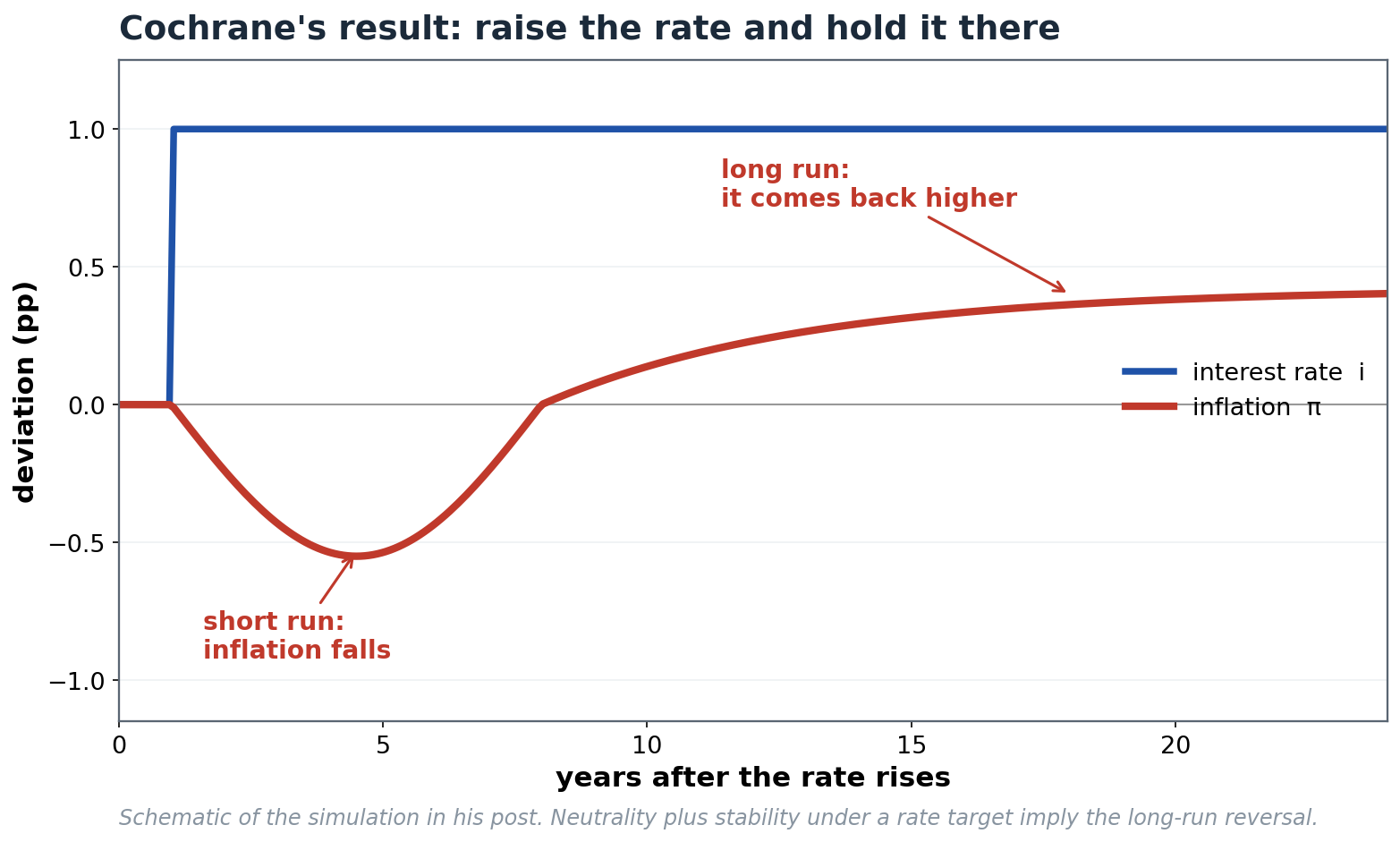
The shape of his simulation: the rate steps up and stays up, inflation falls for several years, then returns above where it began.
He is careful to explain why this is not a crank position. It follows from two propositions that almost every contemporary model contains.
The first is long-run neutrality: real outcomes do not depend on the units in which prices are quoted, so a permanently higher nominal rate must eventually correspond to higher inflation rather than a permanently higher real return.
The second is stability under an interest-rate target, which the long quiet zero-bound decade did a great deal to support. Put neutrality and stability together and the conclusion is close to unavoidable. Most modellers simply do not ask the question, because they look at the first few quarters and stop.
From this he draws a conclusion about 2022: the Fed’s hikes brought inflation down faster than it otherwise would have come down, at the cost of a small persistent addition to inflation later.
On his reading we are now living in the right-hand side of his own simulation. It is Sims’s stepping on a rake, and it is why the 1970s took three attempts. Durable disinflation, he argues, arrived only when fiscal and microeconomic reform came with it. “It’s 1979 again.”
Then his metaphor, which is the best thing in the piece and which I am going to spend the rest of this post arguing with. The FOMC, he says, is driving a bus down a highway in a crosswind. Turning the wheel to the left first sends the bus to the right, and only later pushes it back to the left.
I think that is right about the interest rate. I think it is a description of a badly designed steering column rather than of an unavoidable feature of the road.
And there is one paragraph where Cochrane and I disagree more sharply than anywhere in his book.
Cochrane writes that Warsh is “wisely in my view” climbing down from extensive forward guidance, replacing it with something Draghi-like.
I have written three posts in the past week arguing the opposite. What makes it worth writing a fourth is that Cochrane then, two paragraphs later, asks the question that demolishes his own endorsement.
The rest of this post is for paid subscribers.
Below the paywall: the paragraph where Cochrane undercuts his own praise of Warsh, and why “where’s the stick?” is the same objection I have been making in different words; why the Draghi comparison fails on the one detail that made Draghi work; how his bus metaphor dissolves the moment you stop steering by the wheel and start steering by the road; why the long-run conundrum in his simulation is an artifact of a framework with no nominal anchor rather than a fact about the world; and the assumption in his own footnotes that determines the entire result.
If you have been reading this newsletter for a while and the arguments have been useful to you, a paid subscription is the simplest way to say so.
