Checkers and Chess
America’s Strategic Incoherence and the Risk of Petrodollar Collapse

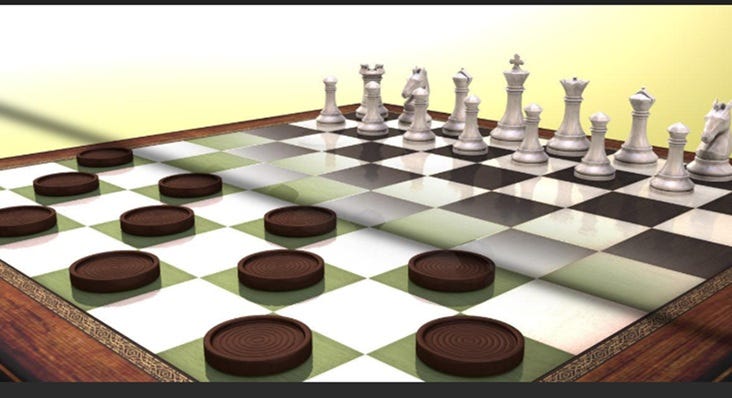
In this conflict, the widely used checkers/chess metaphor comes to mind — America plays checkers while Iran plays chess. But as the war advances in its third week, I think that framing may be too generous to the American side.
Checkers at least implies a coherent player sitting across the board, thinking a move or two ahead. What we are witnessing from Washington is something more chaotic than that — a man who has wandered into a chess match, knocked the pieces onto the floor, tweeted that he won, and is now asking his opponents to please help him pick them up.
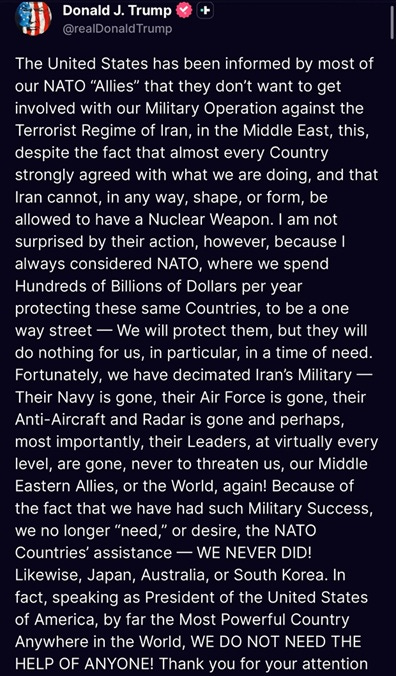
The incoherence is not subtle. Within the span of days, the Trump administration has declared victory, admitted it needs help, alienated the allies whose assistance it now requires, and begun soliciting that same assistance from strategic adversaries — China, of all countries — to help secure a waterway that American airpower has theoretically dominated for eighteen days.
This is not strategy. It is improvisation dressed up in the language of strength, and the world is watching.
Why, in nearly half a century of bombastic threats, the United States and Iran had never actually fought a war? This is something that Trump certainly never asked himself.
Meanwhile, in Tehran, something altogether different has been unfolding.
A Regime That Survived Its Own Assassination
The first thing to understand about Iranian strategic behavior in this conflict is that the Islamic Republic has accomplished something that almost no government in modern history has managed: it executed a peaceful transfer of supreme authority in the middle of an active war in which the previous supreme leader was killed by an enemy airstrike.
Ali Khamenei was assassinated on the first day of the conflict. Within a week, Mojtaba Khamenei had been installed as his successor. The transition was messy, and the new supreme leader has reportedly been wounded. But the regime did not collapse. The chain of command held.
The institutional architecture of the Islamic Republic, battered and degraded as it is, absorbed the single greatest shock an enemy could deliver — the decapitation of its top leadership — and kept functioning.
This matters enormously. American and Israeli war planners appear to have assumed, or at least hoped, that removing Khamenei would trigger an internal collapse, either through a popular uprising emboldened by the chaos or through elite defection and institutional disintegration. Neither happened.
The regime responded with coordinated missile and drone barrages, successfully closed the Strait of Hormuz, and then — most significantly — began negotiating from a position of surprising strategic leverage.
The missile capacity has been degraded. The navy is largely on the ocean floor. The nuclear program has been set back. But Iran won the engagement that mattered most: it closed the strait and held it closed.
Every day that the Strait of Hormuz remains even partially blocked is a day that Iran wins the strategic exchange, regardless of what American bombs are destroying on the ground.
Below the paywall I discuss: the strategic significance of Kharg Island and why a US seizure would be tactically satisfying and strategically ruinous; the yuan gambit — Iran’s quiet move to leverage China’s ambitions against the petrodollar system, and why it may be the most consequential development of this entire conflict; and an updated assessment of the two parallel tracks — military and financial — that will determine not just the fate of Iran but the shape of the global order for decades to come.
