Always Two Years Away
For thirty years Iran has been months from a nuclear weapon, according to the same people who just got their war — and still call it surrender.

Marco Annunziata’s verdict on the US-Iran deal is that the West was too soft. Read it again with one fact in front of you: he got his war.
American and Israeli bombs destroyed Iran’s enrichment sites and killed Ayatollah Khamenei along with much of the regime’s leadership. Its defenses and command were, in his own word, pulverized. And his conclusion is that this was a surrender, that the real answer was to crush Iran, and that we lacked the stomach for it.
That is the whole story in one move. The hawks got the war they asked for, and it still was not enough. No bombing satisfies the case, because the case was never about a bomb on a date. It is a posture, and the posture has no off switch.
The bomb that never arrives
Look at the claim under everything else: Iran is about to go nuclear.
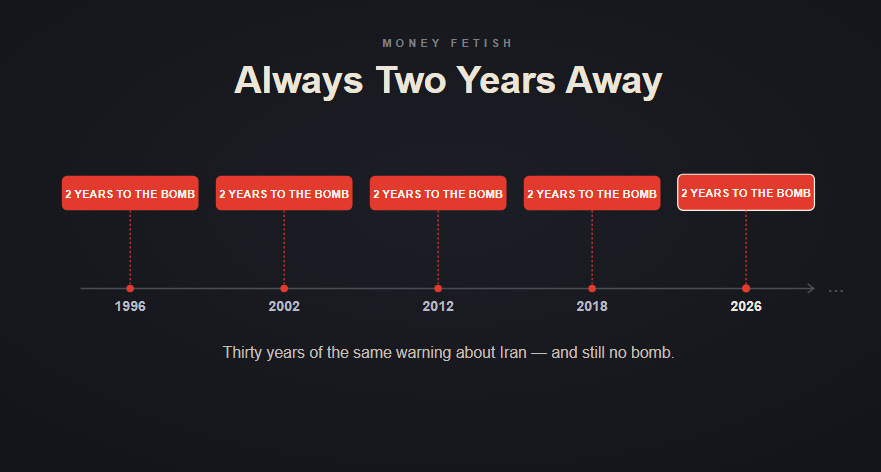
We have been told this for thirty years. In the early 1990s, Iran was three to five years from a weapon. In the late 1990s, five years. Through the 2000s it was a year away, then months away, then weeks from “breakout.” In 2012 the warning came with a cartoon bomb and a red line at a United Nations podium. Every few years the clock is reset to the same alarming number, and every few years the deadline passes with no weapon.
A forecast that has been wrong for three decades is not a forecast. It is a fixed belief wearing a date. And it is being used, again, to justify a war.
The real record cuts the other way. In 2007 the US intelligence community judged, with high confidence, that Iran had halted its weapons work in 2003. For most of these thirty years Iran had the capacity to enrich and chose not to build the weapon.
The hawks read capability as intent and intent as imminence, and they have been wrong at every link in that chain, year after year.
A claim built to survive any result
The reason the “cusp” never goes away is that the argument is built so that nothing can refute it.
If Iran does not build a bomb, that proves the threats and the bombing worked. If Iran does build one, that proves we should have hit harder and sooner. If a deal is signed, it is a surrender. If no deal is signed, the danger is growing. Every possible outcome is folded back into the same conclusion: more pressure, more force, less talk.
This is the same shape as “it wasn’t real socialism” or “it wasn’t real libertarianism.” A theory that explains every result equally well explains none of them. It cannot be tested, so it cannot be trusted. It can only be believed.
His own essay refutes him
The tells are all inside Annunziata’s piece.
He admits the United States suffered very limited economic damage. He admits the economy kept powering ahead and the rest of the world muddled through. He writes that we caved because we were slightly uncomfortable, not because we had been brought to our knees.
Set that beside the claim that this was an existential, overdue war. If the cost of standing firm was that small, then either the threat was not existential, or the war was not about the threat. He cannot have both.
He admits more. Under the 2015 deal, he writes, monitoring by and large worked and had slowed Iran’s program. He admits that when the US walked out of that deal in 2018, it gave Iran a reason to stop complying and accelerate. Read that slowly. The agreement was working. The hawks tore it up. The acceleration they now cite as proof of Iranian bad faith was set off by their own preferred move. They lit the fire and are pointing at the smoke.
And the final tell: he calls the end of a war a surrender. A war sold as necessary and overdue, that pulverized the enemy’s program, ends in a deal its own supporters call a capitulation. If victory on the battlefield produces surrender at the table, the war did not achieve much. That is not an argument for the war. It is evidence against it.
The false choice
The piece offers two options: crush Iran, or surrender. It even reaches for a boxing lyric to make the point —”Some have the speed, and the right combinations. If you can’t take the punches, it don’t mean a thing.”
The real history is the thing that binary erases. For thirty years, the tools that were not war kept Iran short of a weapon. Inspections. Sanctions. Sabotage of the centrifuges. Covert operations against the program. Deterrence, plain and simple.
The 2015 deal that verifiably shipped out enriched uranium and put cameras on the sites. None of that was a knockout, and none of it was surrender, and all of it worked better, and at a fraction of the cost, than the war just fought.
A man who can only see two moves on the board will always think the player using the other move is weak. That is a limit of his imagination, not a fact about the world.
We have seen this movie
There is a reason the opening of his essay — rapid, successful, “I came, I saw, I conquered” — should make the hair stand up. That is the script of 2003 on Iraq: Imminent weapons of mass destruction. A quick and clean campaign. A regime that would fold.
The weapons were not there. The campaign was not clean. The cost was measured in years and hundreds of thousands of lives.
The people most certain about Iran’s imminent bomb are the heirs of the people most certain about Iraq’s. The certainty has the same texture and the same disregard for how badly it has aged.
The “weakness” Annunziata mourns cost the US a few uncomfortable weeks and a spike in the oil price that is fading. The strength he wishes we had shown is the strength that produced Iraq. Weigh those two bills against each other before deciding which is the reckless one.
What is true, and what it does not buy
None of this means Iran is harmless. The regime is brutal at home. It arms proxies, it has threatened Israel’s existence, and it enriches uranium past any civilian need. The 2015 deal had real flaws: it expired, and it left the missiles and the proxies untouched. A nuclear Iran would be a genuine danger, and people who say otherwise are not serious.
Grant all of it. It still does not rescue the argument. Real dangers do not require fake deadlines. A regime can be ugly and threatening and still not be two years from a bomb for thirty years running. You can favor pressure, inspections, even the readiness to strike a true dash for a weapon, without believing the war-or-surrender story or trusting the men who have cried imminence since the first Clinton term.
The bomb that is always about to arrive is the perfect enemy. It justifies any action today and excuses any failure tomorrow. It made the deal a surrender before the ink was dry, and it will make the next deal a surrender too.
The people selling it have been wrong for thirty years and wrong about Iraq. They got the war they wanted, and they are calling it weakness. That is the tell. It was never about the date on the bomb. It was about the war.
Postscript: the same word, two diagnoses
Recently, Timothy Snyder published his own verdict on the deal, and it is worth reading next to Annunziata’s. The two men sit at opposite ends of the politics of this war, and they reach the same word for the result: surrender.
That agreement is the tell. The hawk who wanted the war and the critic who loathed it both look at the outcome and call it a capitulation. They part only on the cause. Annunziata says the US used too little force. Snyder says the force was the folly — a war begun on a whim, with no strategy and no second move once Iran closed the Strait of Hormuz.
Snyder’s point is the one that finishes Annunziata’s. “We should have crushed them” assumes there was a victory to squander. There was not. Once Iran could close the strait and the US had no answer but to call retreat a triumph, the war held no winning path. You cannot crush your way past a chokepoint you have no plan for. The strength Annunziata mourns was never on the table.
Which is where this started. The choice was never war or surrender. It was false twice over: the tools short of war had worked for thirty years, and the war itself held no victory.
A campaign sold on a thirty-year-old “certainty” was launched with no idea how it would end. That is what the permanent cusp buys — not safety, but a war entered on faith and left in humiliation, with even its supporters and its critics agreeing on the last part.
Snyder’s essay is its own polemic, and it leans on the same fear of an Iranian bomb that this post has questioned. It does not settle everything. But on the one claim that matters most to Annunziata’s case — that this was a strong hand played weakly — Snyder is right. There was no strong hand.